


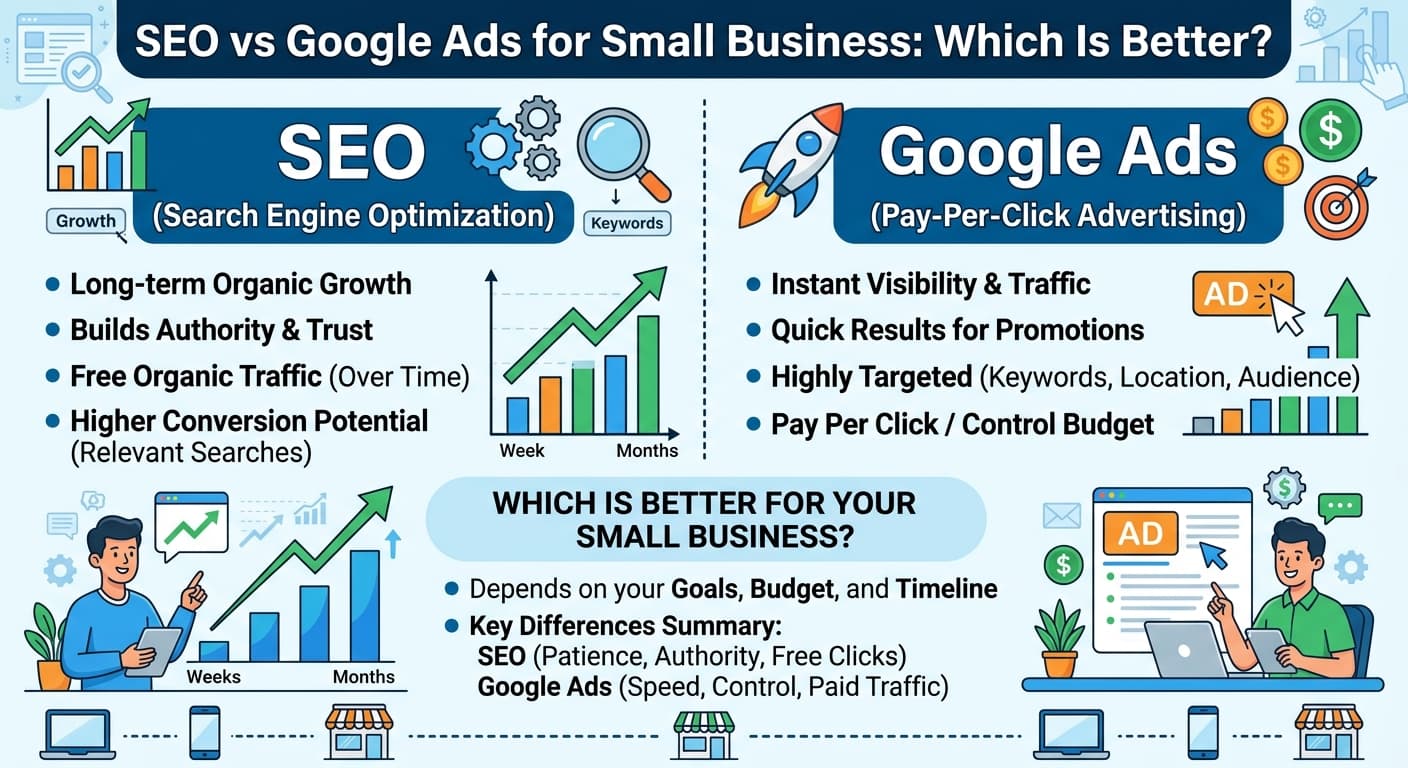
Small businesses often compare SEO with Google Ads when deciding how to attract more customers online. Both can place your business in front of people searching for your products or services, but they work in different ways.
Google Ads can provide visibility quickly, but you normally pay whenever someone clicks your advert. SEO generally takes longer because it involves improving your website and building its organic search presence. However, successful SEO can continue generating visibility without requiring payment for every visit.
The right choice depends on how quickly you need enquiries, your available budget, the competitiveness of your market and whether you are prepared to invest in longer-term growth.
This guide compares SEO vs Google Ads for a small business to help you decide which approach is more suitable.
What Is the Difference Between SEO and Google Ads?
Search engine optimisation, or SEO, is the process of improving a website so its pages can appear more prominently in Google’s unpaid search results.
SEO can include:
- Keyword research
- Service-page optimisation
- Helpful blog content
- Technical website improvements
- Internal linking
- Local SEO
- Google Business Profile optimisation
- Relevant links and business citations
- Performance monitoring
Google Ads is an advertising platform that allows businesses to pay for placements within Google’s search results and other advertising networks.
With a search advertising campaign, you select keywords, write adverts and choose the locations in which you want those adverts to appear. You will typically be charged when someone clicks an advert.
The basic distinction is straightforward:
SEO builds organic search visibility, while Google Ads purchases advertising visibility.
SEO vs Google Ads for Small Business at a Glance
| Factor | SEO | Google Ads |
|---|---|---|
| Speed | Usually takes time to develop | Campaigns can generate visibility quickly |
| Cost model | Investment in optimisation, content and authority | Usually charged for each advert click |
| Traffic after spending stops | Existing rankings may continue producing visits | Advertising traffic generally stops |
| Keyword control | Google determines which pages and searches are relevant | Advertisers can select and exclude keywords |
| Location targeting | Influenced by website and local relevance | Precise geographical targeting is available |
| Testing | Results take longer to evaluate | Keywords and offers can be tested quickly |
| Long-term potential | Can build lasting organic visibility | Requires continued advertising expenditure |
| Predictability | Rankings and traffic can fluctuate | Greater control, although results are not guaranteed |
Neither channel is automatically better. Each one solves a different marketing problem.
How Quickly Can SEO Produce Results?
SEO does not normally deliver immediate results. Google must crawl, process and reassess changes made to a website, while the business must compete against pages that may already have stronger content, links and established authority.
The time required depends on factors including:
- The condition of the existing website
- The competitiveness of the keywords
- The business location
- The quality of competing websites
- The strength of the business’s existing search presence
- The amount and quality of work completed
- Whether the site has technical or indexing problems
A small business in a relatively uncompetitive local market may see movement sooner than a company entering a competitive national industry.
Google advises that some website changes can affect search results relatively quickly, while others may take several months. SEO should therefore be treated as a continuing investment rather than a one-off shortcut.
How Quickly Can Google Ads Produce Results?
A Google Ads campaign can begin displaying adverts shortly after it is created and approved. This makes it useful when a business needs visibility without waiting for organic rankings to improve.
However, immediate visibility does not necessarily mean immediate profitability.
A campaign still requires:
- Accurate keyword targeting
- Appropriate location settings
- Negative keywords
- Persuasive advert copy
- A relevant landing page
- Call and form tracking
- Regular search-term reviews
- Bid and budget management
Poorly configured campaigns can spend money on irrelevant searches, unsuitable locations or visitors who are unlikely to become customers.
Google Ads is fast, but its speed makes accurate setup and measurement more important—not less.
Is SEO Cheaper Than Google Ads?
SEO is sometimes described as free because businesses do not pay Google whenever someone clicks an organic search result. That description can be misleading.
Effective SEO still requires resources. A business may need to pay for strategy, content, technical improvements, website development, local optimisation and ongoing monitoring. Our guide to SEO packages for small businesses explains what an appropriate package should cover.
The difference lies in how the investment works.
With Google Ads, the business usually pays for each click. Competitive commercial keywords can be expensive, and costs continue for as long as the campaign runs.
With SEO, the business pays for the work required to improve its organic visibility. A page that achieves strong rankings may continue attracting visitors without a separate advertising charge for each click.
This can make SEO more cost-effective over time, but only when the strategy attracts relevant traffic and supports genuine business enquiries.
When Should a Small Business Choose Google Ads?
Google Ads may be the stronger initial choice when a business needs enquiries quickly.
It can be particularly useful when:
- The business has recently launched
- The website has little organic visibility
- A specific service needs immediate promotion
- The business operates in a defined service area
- The value of one new customer can justify the advertising cost
- The company wants to test a new offer
- Demand changes seasonally
- The business can track calls, forms and sales
For example, a heating company may use Google Ads to promote emergency repairs during a cold period. A solicitor may advertise a specific legal service in selected locations. An ecommerce business may use advertising to test demand for a new product category.
In each case, the campaign provides rapid market feedback.
When Should a Small Business Choose SEO?
SEO is usually more appropriate when a business wants to build sustainable visibility and reduce its dependence on paid traffic.
It may be the better priority when:
- Customers regularly search for the service
- The business intends to operate for the long term
- The website can support dedicated service pages
- Several products, services or locations need visibility
- The company can wait for results to develop
- Advertising clicks are particularly expensive
- The business wants to strengthen its wider online presence
- The available advertising budget would purchase very little useful traffic
Local businesses can also benefit from improving their Google Business Profile, location signals and service information.
Google explains that local organic visibility is primarily influenced by relevance, distance and prominence. Businesses cannot simply pay Google to improve their unpaid local ranking.
Which Produces Better-Quality Leads?
Lead quality depends more on search intent and targeting than on whether a visitor arrives through SEO or advertising.
Someone searching for “emergency plumber near me” may be ready to call immediately. Someone searching for “how to prevent a leaking tap” may only want information.
Both SEO and Google Ads can attract high-intent searches, but they provide different levels of control.
Google Ads allows advertisers to select target keywords, locations, schedules and audiences. Negative keywords can also prevent adverts from appearing for certain searches.
SEO provides less direct control because Google determines which pages are relevant to each search. Careful keyword mapping and page optimisation can improve relevance, but a website may still receive visits from queries with different levels of commercial intent.
A successful strategy focuses on searches connected to real services, customer problems and purchasing decisions rather than traffic volume alone.
What Happens When You Stop Paying?
This is one of the most significant differences between SEO and Google Ads.
When advertising is paused, the adverts stop appearing and paid traffic normally ends. Any useful campaign data remains, but continued visibility requires further advertising expenditure.
SEO can continue producing visits after active work is reduced. Existing pages, links and local visibility do not automatically disappear when a monthly campaign ends.
However, organic performance is not permanent or guaranteed. Competitors may improve their websites, Google may reassess results and information can become outdated. Technical problems can also affect rankings.
SEO therefore creates a more durable marketing asset, but that asset still requires maintenance.
That maintenance can include content improvements, technical checks, performance analysis and adjustments based on changing search demand. Learn more about what can be included in our monthly SEO services.
Can SEO and Google Ads Work Together?
Small businesses do not always need to choose one channel exclusively. SEO and Google Ads can support each other when the budget allows.
Google Ads can be used to:
- Generate visibility while SEO develops
- Test keywords before creating new pages
- Identify search terms that produce enquiries
- Evaluate landing-page messages
- Promote seasonal or urgent services
SEO can then be used to:
- Build organic visibility for proven searches
- Develop service and location pages
- Answer questions that occur earlier in the buying process
- Reduce long-term dependence on paid clicks
- Strengthen the business’s wider search presence
Advertising data should not be copied blindly into an SEO strategy, but it can provide useful evidence about customer language and commercial intent.
For example, if a particular advertising keyword regularly produces qualified enquiries, the business can investigate whether it also deserves a dedicated organic landing page.
SEO can then target the same underlying customer demand without attempting to copy the advert or force unrelated keywords onto one page.
A Practical Strategy for a Small Business
For many small businesses, the strongest approach is to introduce the two channels in stages.
1. Prepare the Website
Before investing heavily in either channel, make sure the website clearly explains:
- What the business offers
- Who the service is for
- Which locations are covered
- Why a customer should make contact
- How to call, enquire or purchase
The site should also work properly on mobile devices and load without avoidable delays.
Sending paid or organic visitors to a confusing page is unlikely to produce strong results regardless of the traffic source.
2. Configure Conversion Tracking
Track relevant actions such as:
- Telephone calls
- Contact-form submissions
- Appointment bookings
- Quote requests
- Product purchases
Clicks and rankings alone do not show whether marketing is generating business.
A campaign receiving fewer visits can still be more valuable if those visitors are more likely to become customers.
3. Test Immediate Demand With Focused Advertising
If the budget permits, run a controlled Google Search campaign for one or two valuable services rather than advertising everything at once.
Use tightly relevant keywords, appropriate location targeting and negative keywords. Review the actual search terms triggering the adverts instead of relying only on the keywords initially selected.
This can help the business identify which searches produce meaningful enquiries and which ones waste budget.
4. Develop Organic Pages Around Genuine Demand
Create useful pages for important services, customer problems and locations. Each page should have a distinct purpose rather than repeating the same keywords across multiple URLs.
Useful organic pages should answer the questions a potential customer needs resolved before making contact.
They should also provide a clear route towards the appropriate product, service or enquiry method.
5. Compare Leads and Revenue
Evaluate both channels according to:
- Qualified enquiries
- Cost per lead
- Conversion rate
- Customer value
- Revenue generated
- Lead quality
The cheapest click is not necessarily the best click, and the highest-ranking keyword is not necessarily the one producing customers.
Should a Small Business Use SEO or Google Ads First?
A new business requiring immediate enquiries may choose Google Ads first, provided it has an appropriate budget, a strong offer and a page capable of converting visitors.
A business with a limited budget and no urgent sales requirement may choose to establish its SEO foundations first. This could include fixing the website, improving service pages and completing its Google Business Profile.
Another option is to run a small, tightly controlled advertising campaign while developing organic visibility in the background.
The decision should not be based solely on which channel appears cheaper. It should reflect how urgently the business needs customers and whether it can sustain the investment long enough to obtain meaningful results.
SEO or Google Ads: Which Should You Choose?
Choose Google Ads when speed, testing and targeting control are the main priorities.
Choose SEO when the goal is to build lasting organic visibility and reduce the need to pay for every website visit.
If the business needs leads immediately but also wants sustainable growth, Google Ads can capture current demand while SEO develops in the background.
A business with a very limited budget should be careful not to spread its investment too thinly. If the advertising budget can purchase only a handful of expensive clicks, it may be more sensible to improve the website, Google Business Profile and core organic pages first.
The final decision should be based on customer value, market competition, available budget and how quickly the business needs results.
For help building sustainable visibility around your most important services, explore our small business SEO service.
Frequently Asked Questions
Is SEO Better Than Google Ads for a Small Business?
SEO is usually better for developing long-term organic visibility, while Google Ads is better for obtaining rapid, targeted exposure. The stronger choice depends on the business’s timescale, budget and customer value.
Should a New Business Start With SEO or Google Ads?
A new business can use Google Ads to test demand and generate initial visibility while developing its SEO foundations. If the advertising budget is too limited to collect useful data, the business may be better starting with its website, Google Business Profile and essential SEO work.
Can a Small Business Use SEO and Google Ads at the Same Time?
Yes. Advertising can capture immediate searches while SEO works towards longer-term visibility. Conversion tracking should be used so the business can compare the leads and revenue produced by each channel.
Does SEO Keep Working When You Stop Paying?
Organic rankings may continue generating traffic after active work stops, but results are not permanent. Competitors, website changes and search-result updates can affect performance, so periodic maintenance is still important.
Are Google Ads Guaranteed to Generate Customers?
No. Google Ads can generate clicks and visibility, but it cannot guarantee enquiries or sales. Results depend on targeting, competition, the offer, landing-page quality and the business’s ability to convert visitors.
Is SEO Free?
Businesses do not normally pay Google for individual organic clicks, but SEO itself requires time, expertise and resources. Costs may include content, technical improvements, strategy, local optimisation and ongoing monitoring.