


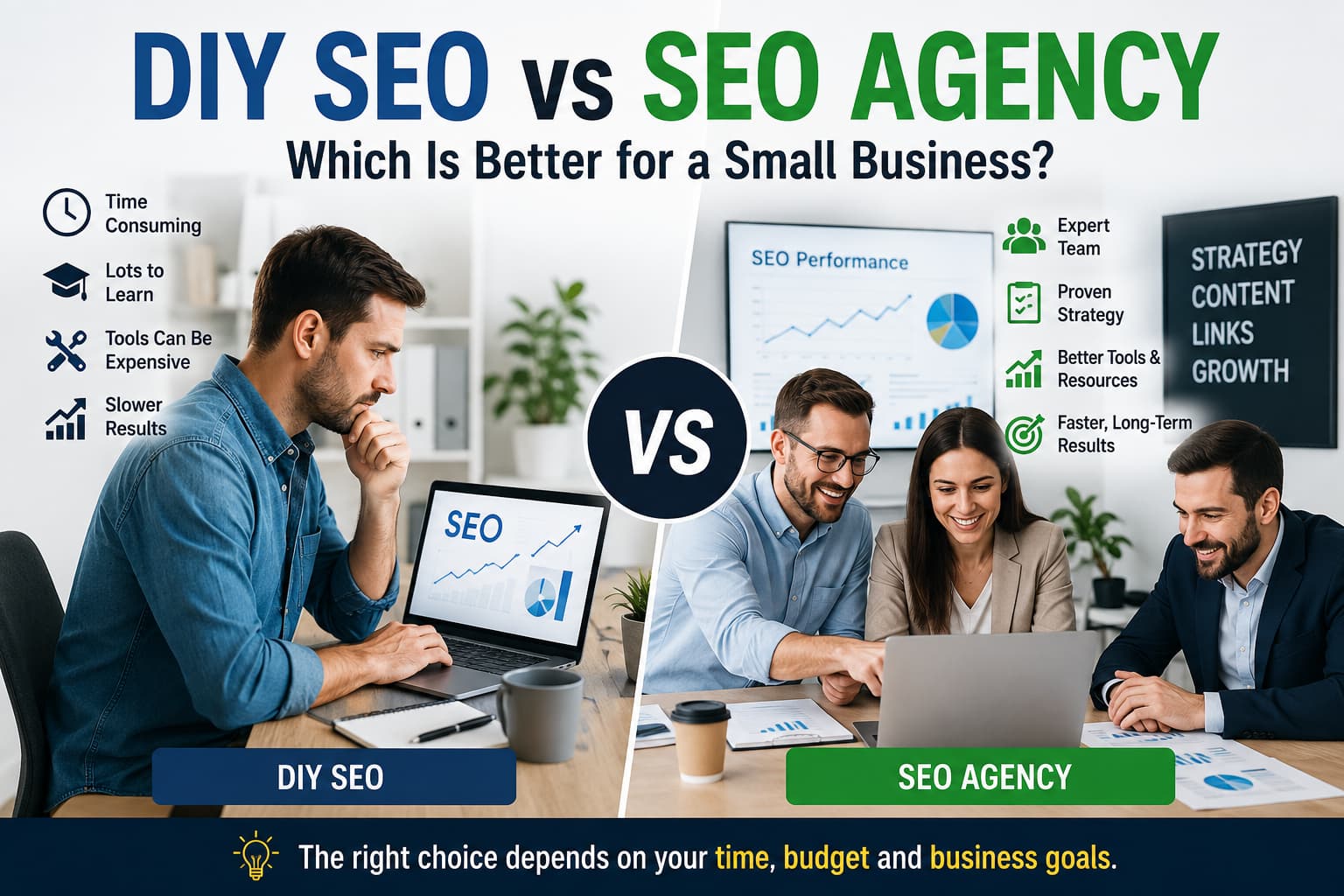
Small-business owners often face a straightforward question: should they manage SEO themselves or hire an SEO agency?
DIY SEO can reduce upfront costs and give business owners direct control over their websites. However, it also requires time, technical knowledge and consistent implementation. Hiring an agency costs more, but it can provide access to specialist skills, tools and a structured strategy.
The right option depends on your budget, available time, website condition, competition and growth goals.
This guide compares DIY SEO with professional agency support so that you can decide which approach is most suitable for your business.
What Does DIY SEO Involve?
DIY SEO means managing some or all search optimisation work internally rather than paying an external provider.
This may include:
- researching keywords;
- updating page titles and descriptions;
- writing service-page content;
- publishing blog articles;
- improving internal links;
- checking indexing in Google Search Console;
- optimising a Google Business Profile;
- monitoring rankings and traffic;
- fixing basic technical issues;
- building business citations.
Business owners can learn many SEO fundamentals through reliable guides and practical experience. For a small website in a low-competition market, this may be enough to establish a useful foundation.
However, SEO is not a one-time task. Results usually depend on regular improvements, monitoring and adaptation.
Benefits of Doing SEO Yourself
Lower Initial Cost
The most obvious advantage is reducing agency fees.
A business owner may be able to complete basic work without committing to a monthly SEO package. This can be useful for a new company with limited cash flow.
However, DIY SEO is not completely free. Costs may still include:
- keyword research software;
- rank tracking;
- website plugins;
- content tools;
- technical support;
- training;
- the value of the owner’s time.
A task that costs nothing financially may still become expensive when it takes several hours away from sales, operations or customer service.
Greater Control
Managing SEO internally gives the business direct control over:
- page changes;
- content tone;
- publishing schedules;
- service information;
- business priorities.
The owner often understands the company, customers and services better than an external provider initially does.
That knowledge can be particularly valuable when creating accurate service content and answering real customer questions.
Better Understanding of Website Performance
Learning the basics of SEO can help a business owner understand:
- where website enquiries come from;
- which pages perform well;
- what customers search for;
- why certain pages are not indexed;
- how content supports sales.
Even when a company later hires an agency, this knowledge can make it easier to review reports and evaluate whether useful work is being completed.
Limitations of DIY SEO
SEO Requires Time
SEO involves more than adding keywords to pages.
A complete strategy may require:
- competitor research;
- keyword mapping;
- content planning;
- technical auditing;
- page optimisation;
- internal linking;
- link acquisition;
- conversion tracking;
- performance reporting.
Completing these tasks properly can take several hours each week.
A business owner should consider whether this time would generate more value when spent serving customers, managing staff or developing sales.
Technical Problems Can Be Difficult to Diagnose
Some SEO issues are relatively simple. Others require a stronger understanding of WordPress, hosting, indexing, structured data or website architecture.
Examples include:
- incorrect canonical tags;
- pages blocked from indexing;
- redirect chains;
- duplicated URLs;
- JavaScript rendering issues;
- poor Core Web Vitals;
- conflicting SEO plugins;
- faceted navigation problems;
- website migration errors.
Making the wrong technical change can reduce visibility rather than improve it.
Tools and Data Can Be Expensive
Professional agencies often use paid platforms for:
- keyword research;
- competitor analysis;
- backlink analysis;
- technical crawling;
- rank tracking;
- content research;
- reporting.
A small business can purchase these tools independently, but several subscriptions may cost more than expected.
The owner must also know how to interpret the data. A large list of errors or keywords is not useful without knowing which actions should be prioritised.
Progress May Be Slower
DIY SEO is often completed around other responsibilities. This can lead to:
- inconsistent publishing;
- unfinished page updates;
- delayed technical fixes;
- limited link building;
- weak reporting;
- changing priorities.
SEO generally performs better when important tasks are completed consistently rather than occasionally.
What Does an SEO Agency Do?
An SEO agency should provide more than automated reports or generic task lists.
A professional campaign may include:
- reviewing the website and competitors;
- identifying valuable search terms;
- mapping keywords to appropriate pages;
- correcting technical issues;
- improving service and category pages;
- planning supporting content;
- strengthening internal links;
- developing relevant authority;
- tracking calls, forms or sales;
- reporting on completed work and results.
The precise activities should depend on the business rather than following an identical checklist for every client.
Benefits of Hiring an SEO Agency
Access to Specialist Knowledge
An agency may have experience across technical SEO, content, local search, analytics and link acquisition.
This can be valuable when a website has complex problems or competes in a difficult market.
Instead of learning every area personally, the business can use specialists who already understand the tools and processes involved.
Faster Implementation
An agency should have systems for:
- auditing websites;
- prioritising issues;
- preparing content briefs;
- improving pages;
- tracking performance;
- reporting progress.
This can help important work move forward without depending entirely on the business owner’s available time.
Faster implementation does not guarantee immediate rankings, but it can reduce delays caused by inconsistent execution.
Clearer Prioritisation
Websites often contain dozens or hundreds of potential issues. Not every issue has the same effect.
A good agency should distinguish between:
- urgent indexing problems;
- high-value commercial page improvements;
- minor technical warnings;
- content opportunities;
- longer-term authority work.
Prioritisation prevents the budget from being spent on low-impact tasks while important pages remain weak.
Ongoing Monitoring
Search performance changes over time.
An agency can monitor:
- rankings;
- search impressions;
- clicks;
- conversions;
- indexing;
- competitor movement;
- website changes;
- technical errors.
Regular monitoring helps identify problems before they become more serious and allows the strategy to be adjusted according to results.
Limitations of Hiring an SEO Agency
Monthly Cost
Hiring an agency requires a financial commitment.
The cost depends on:
- website size;
- competition;
- geographic targeting;
- services provided;
- number of pages;
- content requirements;
- authority-building requirements.
Businesses should evaluate the cost against the potential value of new customers and the time saved internally.
Quality Varies Between Providers
Not every SEO agency provides the same standard of work.
Warning signs may include:
- guaranteed first-position rankings;
- unclear deliverables;
- no access to reports or accounts;
- automated reports without explanation;
- bulk low-quality backlinks;
- duplicated content;
- no conversion tracking;
- long contracts with vague cancellation terms.
Before hiring a provider, ask what work will be completed, how priorities are selected and how performance will be measured.
The Agency Still Needs Business Input
An external provider cannot understand every product, service or customer immediately.
The business may still need to provide:
- service details;
- target locations;
- commercial priorities;
- customer questions;
- photographs;
- approvals;
- industry knowledge.
The strongest campaigns usually involve cooperation between the agency and the business rather than handing over the website with no communication.
DIY SEO vs SEO Agency: Cost Comparison
DIY SEO may appear cheaper because there is no agency fee. However, the real cost includes:
- the owner’s time;
- software subscriptions;
- training;
- content creation;
- technical help;
- mistakes or delays.
Hiring an agency creates a visible monthly cost, but that fee may include access to several specialists, tools and implementation resources.
The decision should not be based only on which option has the lowest price. It should consider which approach is likely to produce consistent, commercially useful work.
Businesses comparing professional options can review our SEO packages for small business.
When DIY SEO May Be Suitable
DIY SEO may be suitable when:
- the website is small;
- competition is relatively low;
- the owner has time to learn;
- the business is not dependent on rapid growth;
- only basic improvements are required;
- the budget is currently limited;
- someone internally enjoys working with websites and data.
A practical DIY starting point may include:
- Setting up Google Search Console.
- Checking that important pages are indexed.
- Improving key service-page titles and headings.
- Creating useful service descriptions.
- Strengthening internal links.
- Updating business listings.
- Requesting genuine customer reviews.
- Tracking calls and enquiries.
When Hiring an Agency May Be Better
Professional support may be more appropriate when:
- the market is competitive;
- organic visibility is commercially important;
- the website has technical problems;
- several services or locations are being targeted;
- traffic has declined;
- previous SEO work has failed;
- internal staff do not have enough time;
- the business needs regular content and authority building;
- results and conversions need proper tracking.
An agency may also be useful when the business has completed basic DIY work but cannot move beyond its current rankings.
Can a Business Combine DIY SEO With Agency Support?
Yes. A hybrid approach can work well.
For example, the agency might handle:
- strategy;
- technical SEO;
- keyword research;
- page planning;
- reporting;
- authority development.
The business might contribute:
- industry expertise;
- photographs;
- customer questions;
- service information;
- case studies;
- content approvals.
This can reduce delays and produce more accurate content while keeping specialist work with experienced professionals.
Questions to Ask Before Hiring an SEO Agency
Ask potential providers:
- What will be completed each month?
- Which pages will be prioritised first?
- How do you choose target keywords?
- Will I own my website, content and accounts?
- How do you measure enquiries and sales?
- Do you provide technical implementation?
- Is content included?
- How do you approach link building?
- What reporting will I receive?
- What are the cancellation terms?
- How long should meaningful progress take?
Clear answers help distinguish a structured service from a vague monthly retainer.
Final Verdict
DIY SEO can be a reasonable starting point for a small, low-competition website when the owner has enough time and willingness to learn.
Hiring an SEO agency becomes more valuable when the website has technical issues, competition is stronger or consistent implementation is required across several areas.
The best choice depends on:
- available budget;
- internal time;
- current website condition;
- business goals;
- competition;
- the value of each new customer.
Whichever approach you choose, focus on meaningful work that improves important pages, user experience and enquiry generation—not simply completing SEO tasks for the sake of activity.
Businesses ready to compare professional options can view Big Ben SEO’s small business SEO pricing and plans.