


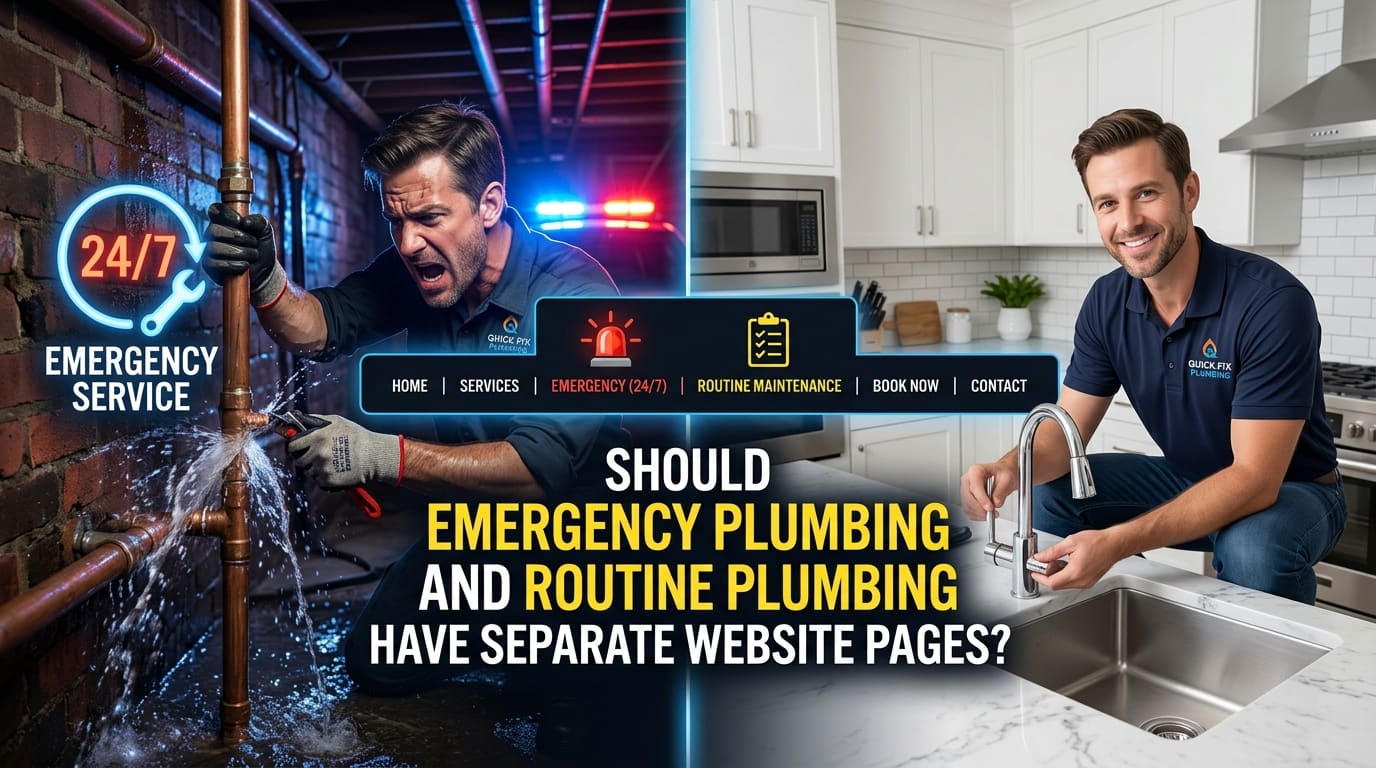
Emergency and routine plumbing should have separate website pages when they involve different customer needs, availability and booking arrangements. If your business handles both through the same process and has little additional information to explain, one well-organised page may be enough.
The decision about emergency and routine plumbing website pages starts with what customers need to know. Someone dealing with an active leak needs a clear contact route and accurate availability. Someone planning a tap replacement needs information about the work, pricing arrangements and how to book.
Separate pages are useful when they make those decisions easier.
How Emergency and Routine Customers Differ
Both customers need a plumber, but they may approach your website with different questions.
| Customer need | Emergency enquiry | Routine enquiry |
|---|---|---|
| Main concern | Can someone help with an urgent problem? | Can someone complete the planned work? |
| Availability | Whether help is available now | Which appointment dates are available |
| Service information | Problems the business can respond to | Work included and any limitations |
| Pricing | Call-out charges and how costs are explained | How to obtain an estimate or quotation |
| Contact route | A clearly visible telephone number | Telephone, enquiry form or booking request |
| Next step | Explain the problem and confirm availability | Describe the job and arrange an appointment |
These differences should shape the content and layout. Changing the heading from “Plumbing Services” to “Emergency Plumbing” while keeping everything else identical offers little additional help.
When Separate Pages Make Sense
An emergency plumbing page is worth considering when your business has a genuine urgent-response service that needs its own explanation.
For example, you may have:
- Different telephone arrangements outside normal working hours.
- A defined emergency coverage area.
- Specific call-out charges.
- A process for assessing urgent enquiries.
- Different availability for urgent and planned jobs.
A separate routine plumbing page can then explain scheduled repairs, replacements and installations without making visitors work through emergency information.
Consider a company that accepts urgent leak enquiries by telephone but arranges bathroom plumbing work after a site visit. Those customers need different instructions. Separate pages can give each group a clearer route.
If your current website mixes these services together, our SEO support for plumbing businesses can help you assess which pages need distinct information.
When One Page Is Enough
A smaller plumbing business may not need separate pages immediately.
One page can work when:
- You mainly provide scheduled appointments.
- Urgent work is accepted only when your diary allows.
- The same team handles all enquiries during the same hours.
- You cannot provide much useful information beyond the existing service description.
In that situation, use clear sections explaining routine work and how you handle urgent requests.
For example:
We provide scheduled plumbing repairs and installations. If you have an urgent problem, telephone us to check availability. We do not operate a guaranteed 24-hour response service.
This gives customers a realistic expectation without creating a separate page that suggests a service you do not provide.
What an Emergency Plumbing Page Should Explain
An emergency page should help visitors establish whether your business can assist and how to contact you.
Problems You Can Respond To
Describe the urgent plumbing problems your team genuinely handles.
Examples might include active water leaks, burst pipes or plumbing faults affecting essential facilities. Only include services within your actual scope.
If you do not handle drainage emergencies, heating faults or gas-related work, make that distinction clear. Customers should not have to telephone before discovering that the advertised service is unavailable.
Actual Availability
State your operating hours and explain how urgent enquiries are handled.
Distinguish between:
- A telephone line that accepts messages.
- A team available to discuss the problem.
- A plumber available to attend.
These are different levels of availability. A form that can be submitted at any time does not establish that a plumber is available around the clock.
Avoid publishing response-time promises unless your business can support them.
Coverage and Attendance Arrangements
Explain the areas you serve and whether urgent attendance depends on location, workload or the nature of the problem.
If you need to assess the enquiry before confirming attendance, say so.
Charges and Approval
Where applicable, explain whether there is a call-out fee, how additional work is priced and when the customer will receive an estimate.
You do not need to publish a fixed price for every fault. You do need to make the charging process understandable.
A Clear Contact Route
Place the appropriate telephone number near the top of the page. Make it easy to use on a mobile phone.
If you also provide a form, explain whether it is monitored for urgent requests. Do not make a visitor complete a lengthy quotation form when your intended process is to telephone first.
What a Routine Plumbing Page Should Explain
A routine page should help customers understand the work and prepare a useful enquiry.
Include:
- Repairs, replacements and installations you undertake.
- Property types you work in.
- Information needed to prepare a quotation.
- Whether a site visit may be required.
- How appointments are requested and confirmed.
- Relevant examples of completed work, where available.
For a tap replacement, useful enquiry details could include the location of the tap, photographs and whether the customer has already purchased a replacement.
For a larger installation, the next step may be a conversation or site assessment rather than an immediate booking.
The page should explain that process without suggesting that submitting a form automatically reserves an appointment.
Avoid Turning Every Plumbing Service into Two Pages
Separating emergency and routine enquiries does not mean every service needs an emergency version.
For example, publishing all of these pages may create unnecessary overlap:
- Plumbing repairs.
- Emergency plumbing repairs.
- Urgent plumbing repairs.
- Same-day plumbing repairs.
Before adding another page, ask what it will explain that the existing page does not.
If the service, availability, coverage and contact process are the same, improving one page may be more useful than maintaining several similar versions.
Google’s guidance recommends a logical site structure and relevant links between important pages. A clear structure should help visitors understand their options.
Give Each Page a Clear Role
A practical structure could look like this:
| Page | Main purpose |
|---|---|
| Plumbing services overview | Introduce the services and help visitors choose |
| Emergency plumbing | Explain urgent enquiries, availability and call-out arrangements |
| Plumbing repairs | Explain scheduled fault diagnosis and repair work |
| Plumbing installations | Explain planned replacements and installation projects |
| Contact page | Provide general contact details and enquiry options |
This is an example, not a requirement for every business.
A plumber offering only a few services may need fewer pages. A business with distinct repair and installation services may need more detailed information.
The important question is whether each page helps someone make a different decision.
Connect the Pages Naturally
Your services overview should link to the relevant emergency and scheduled-work pages.
An emergency page can also direct visitors with non-urgent work towards the appropriate routine service. For example:
Planning a replacement rather than reporting an urgent fault? See our plumbing installation information.
The routine page can explain how to check availability if a problem becomes urgent.
Use link wording that identifies the destination. Google recommends concise, relevant internal link text.
Check navigation, footer details and contact buttons as well. Different pages should not display conflicting telephone numbers or operating hours.
Improve an Existing Page Before Creating Another
If you already have an emergency page, check whether it provides a useful experience before adding more content elsewhere.
Ask:
- Does it accurately describe the service?
- Can visitors find the telephone number immediately?
- Are operating hours and coverage clear?
- Does it explain charges or the quotation process?
- Does it differ meaningfully from the general plumbing page?
- Do its contact links work on a phone?
If an existing page answers the right questions but presents them poorly, update its layout and wording first.
If two pages cover the same service with almost identical information, review whether both are necessary. Do not remove a page without checking its search performance, links and role in the website.
How to Assess Whether the Structure Works
Review emergency and routine enquiries separately where possible.
Useful checks include:
| Check | What it helps you understand |
|---|---|
| Search queries reaching each page | Whether visitors are finding the appropriate information |
| Calls and submitted enquiries | Whether people use the available contact routes |
| Questions received by reception | Which details remain unclear |
| Enquiries for unavailable services | Whether the page creates incorrect expectations |
| Confirmed jobs | Whether enquiries lead to suitable work |
A telephone-button click does not prove a call connected. A submitted form does not prove a job was booked.
Combine website measurements with your enquiry records to understand whether the pages are helping customers reach the right service.
Frequently Asked Questions
Does every plumber need an emergency plumbing page?
No. A separate page is useful when you provide a genuine urgent service with distinct information to explain. If you only offer scheduled work, describe that accurately.
Can an emergency page mention routine plumbing?
Yes. A short explanation and a link can help customers who do not need urgent attendance. Keep the main content focused on the emergency enquiry process.
Should both pages use the same contact form?
They can, provided the form suits both types of enquiry. If urgent customers should telephone, make that instruction prominent and explain how quickly form submissions are reviewed.
Will separate pages automatically improve rankings?
No. Separate pages can make your services clearer, but creating them does not guarantee better rankings. Each page needs a useful purpose and accurate information.
Choose the Structure Your Business Can Support
Create separate pages when emergency and routine work have different availability, service details and enquiry processes.
Keep them together when one page can explain both clearly without misleading visitors.
Before publishing, make sure your team can deliver what each page describes. Accurate hours, clear charges and working contact routes are more useful than additional pages with little distinct information.
For broader website planning and search support, visit Big Ben SEO.
You may also find useful: Why Is Your Plumbing Business Not Showing on Google Maps? and How Should Plumbers Create Pages for Different Service Areas?.

Written by
Ammar Rafique, Founder
Ammar started Big Ben SEO in 2019 to give small and medium sized UK businesses honest, practical SEO with clear priorities and reports that show what changed.
About Ammar · LinkedIn