


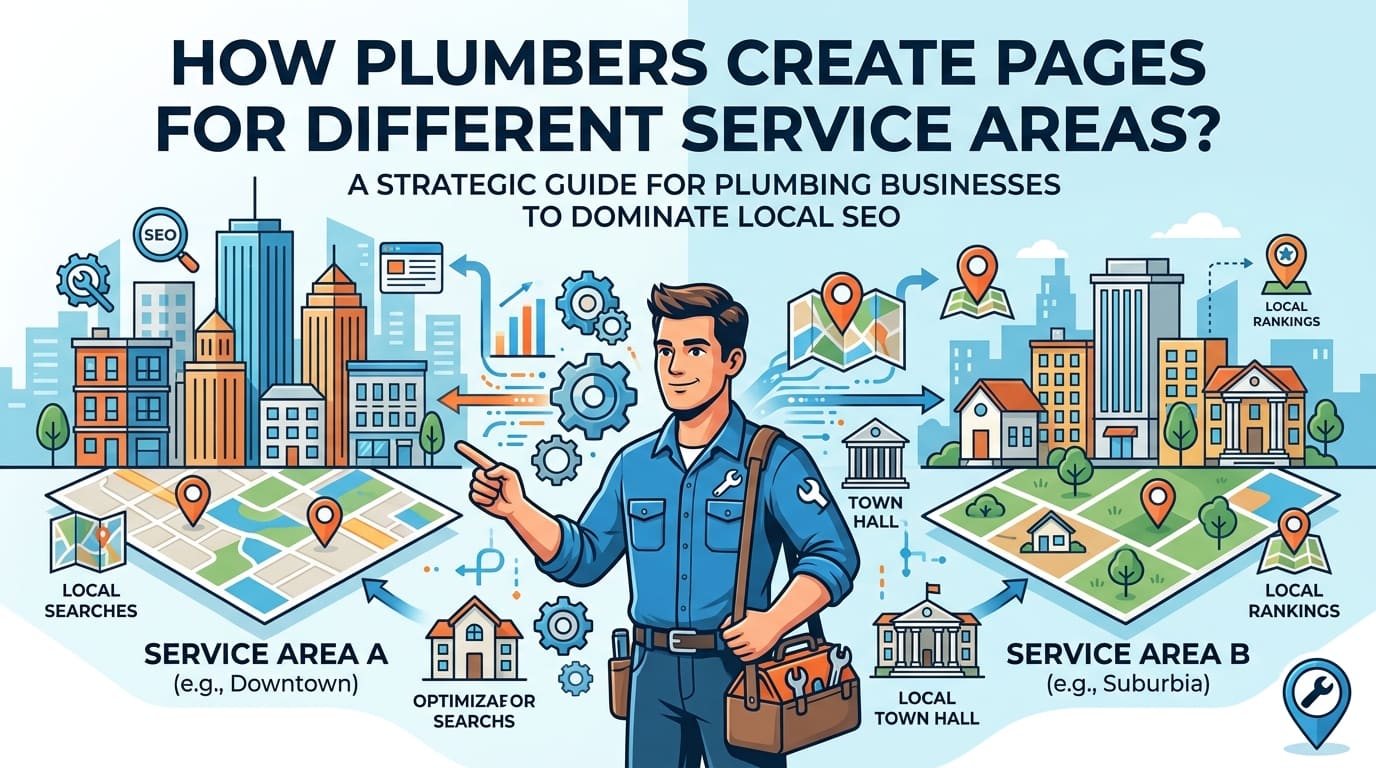
Plumbers should create service area pages for places they genuinely cover, where a dedicated page helps customers understand the services available and how to arrange a visit.
Start with your actual coverage and existing website. Then decide which locations need their own pages and which can sit within a wider coverage page.
Changing the town name in the same paragraph does little to help someone choose a plumber. A useful location page answers practical questions: do you cover their postcode, can you handle their job, and what happens when they contact you?
What are plumber service area pages?
Plumber service area pages are website pages explaining a plumbing business’s services in particular towns, districts or other defined areas.
They are different from service pages:
- A service page explains a job, such as leak repairs or bathroom plumbing.
- A service area page explains availability and relevant services in a location.
- An areas covered page provides an overview of the business’s geographical coverage.
Each page should have a clear purpose. A customer should understand why it exists without needing to read its SEO title.
1. Map your real coverage before choosing locations
Write down where your team can reasonably accept work.
Consider:
- Where engineers travel from.
- Which postcodes you regularly serve.
- Whether coverage differs for urgent and scheduled jobs.
- Whether some areas have additional travel charges.
- Which services are available in each area.
- Whether you accept domestic, commercial or both types of work.
Do not publish a page promising emergency plumbing in a town if you only accept planned appointments there.
For example, a business might offer scheduled bathroom installations across several towns but restrict urgent call-outs to a smaller area. Its website should explain that difference.
Your operational coverage should set the boundaries of your content.
2. Check whether an existing page already serves the location
Before creating a new URL, review your homepage, service pages and existing location pages.
Look at Search Console queries alongside the pages receiving those impressions. Check whether a suitable page already appears for searches involving the town.
Ask:
- Does the existing page clearly explain coverage?
- Is it attracting enquiries from that area?
- Could a short coverage section answer the missing questions?
- Would a new page offer something meaningfully more useful?
Prefer improving a suitable existing page when it can meet the need.
Two pages mentioning the same town do not automatically compete in a harmful way. Review their purpose and query-to-page data before deciding that consolidation is necessary.
3. Decide which locations deserve separate pages
A dedicated page is easier to justify when the location represents a meaningful part of your business and you have useful information to publish.
| Situation | Suggested approach |
|---|---|
| You regularly work in a town and have relevant job examples | Consider a dedicated town page |
| Several small neighbouring areas share the same coverage arrangements | Consider one wider coverage page |
| You occasionally accept work in an area | Explain coverage on an existing page first |
| You cannot reliably serve the location | Do not create a page advertising availability |
| A suitable location page already exists | Improve it before creating another |
| You have no useful detail beyond the town name | Gather information before publishing |
These are planning criteria, not guaranteed ranking rules.
A page should earn its place through customer usefulness, rather than simply matching a location keyword.
4. Keep the website structure easy to navigate
A straightforward structure separates what you do from where you do it.
The following URLs are hypothetical examples:
| Page type | Example URL | Main purpose |
|---|---|---|
| Plumbing overview | /plumbing-services/ | Introduce the available services |
| Individual service | /leak-repairs/ | Explain a particular job |
| Coverage overview | /areas-covered/ | Show the areas genuinely served |
| Town page | /plumber-example-town/ | Explain services and availability in that town |
An existing website does not need to adopt these exact paths. Preserve working URLs unless there is a clear reason to change them.
From the coverage overview, visitors should be able to reach relevant town pages. From a town page, they should be able to reach detailed service information and contact options.
Our SEO services for plumbers cover the wider relationship between service targeting, website structure and local search visibility.
5. Give each town page useful local content
A location page needs more than a local heading and a contact form.
Build it around information your business can verify.
Explain the coverage
State the town or district served and any meaningful boundaries.
If coverage depends on the postcode or type of work, explain that and ask customers to confirm when enquiring.
Identify the services available
List the services genuinely offered in that area. Link to the main service pages for fuller explanations.
Avoid advertising boiler or gas work unless your business offers it and can substantiate the relevant qualifications.
Explain how appointments work
Describe what customers should provide when contacting you, such as:
- Their postcode.
- A brief description of the issue.
- Whether water is actively leaking.
- Photographs, where useful.
- Their preferred appointment times.
Only publish arrival promises, opening hours and call-out arrangements that reflect your actual service.
Include relevant evidence
Where available, add a real local job example, an appropriate photograph or a customer review used with permission.
A useful example explains the problem, the work completed and any practical constraints. Remove identifying customer details that are unnecessary.
Do not invent projects to make a page look established.
6. Use a repeatable layout without repeating the whole article
A shared design helps customers navigate. It is reasonable for location pages to use the same section order and booking process.
However, each page should contain information that supports its own purpose.
A practical layout is:
- Heading and coverage summary.
- Services available in the area.
- Booking and availability information.
- Relevant completed work or other evidence.
- Coverage boundaries and nearby areas.
- Useful questions and contact options.
For example, a location-specific question might be:
Can I book a planned plumbing repair in this area if I do not need an urgent visit?
Answer it using the business’s actual arrangements.
General information, such as the full leak repair process, can remain on the main service page.
7. Avoid creating every service-and-town combination
A plumber offering six services across ten towns does not automatically need sixty pages.
Start with strong service pages and a manageable set of useful location pages.
Consider a combined service-and-location page only when it addresses a distinct customer need and you have enough specific information to support it.
For example, a genuine specialist commercial service with different booking requirements may justify more detail. A copied leak repair page with another town name usually provides little additional value.
Google’s doorway abuse policy includes substantially similar pages and regional pages that mainly funnel visitors elsewhere. The concern is their purpose and usefulness, rather than simply the presence of a town name. developers.google.com
8. Link pages according to what the reader needs
Use internal links to help customers move between coverage, services and booking information.
Useful connections include:
- The areas covered page linking to relevant town pages.
- Town pages linking to services available there.
- Service pages linking to the coverage overview.
- Relevant project articles linking to the associated service or town page.
Use clear anchor text such as “leak repair services” or “plumbing appointments in Example Town”.
Avoid placing a large block of repetitive town-and-service links on every page. Choose links that help someone take the next step.
The same phone number or contact form can appear across location pages. What matters is that each page helps the visitor before asking them to enquire.
9. Keep website coverage and Google Business Profile accurate
A website location page does not establish a physical branch.
If your business travels to customers and does not receive them at its address, Google says to remove that address from the Business Profile and use service areas. Its guidance also states that a service-area business should have one profile for the area it serves. Google Business Profile Help
Do not create a separate profile or invent an office for each town page.
Keep the website’s coverage claims consistent with where the business actually operates. For broader help with this, see our local SEO services.
10. Measure enquiries as well as search visibility
After publishing or improving a location page, monitor:
- Search queries associated with the page.
- Clicks and impressions over a consistent period.
- Whether the intended page appears for relevant searches.
- Enquiries from the area.
- Whether those enquiries concern services you actually offer.
- Confirmed jobs, where your records allow this comparison.
A phone click is not the same as a completed call. A form submission is not the same as a booked job.
If a page gets visibility but produces unsuitable enquiries, check whether its service and coverage information is clear.
If several pages repeatedly appear for the same queries, inspect their content and purpose before changing URLs or adding redirects.
Checklist before publishing a plumber service area page
| Check | Question to answer |
|---|---|
| Real coverage | Can we reliably accept work here? |
| Existing content | Is there already a suitable page? |
| Customer value | What does this page help someone decide? |
| Services | Are all advertised services available here? |
| Local evidence | Are examples, photographs and reviews genuine? |
| Availability | Are booking and urgent call-out claims accurate? |
| Business identity | Have we avoided implying a branch that does not exist? |
| Navigation | Can visitors find services and contact information easily? |
| Measurement | Can we distinguish enquiries from confirmed jobs? |
Create location pages gradually, starting with areas where you have real coverage and useful information. Expand when another page can answer a customer need that your existing content does not adequately address.
For help planning service and location pages around your actual coverage, explore Big Ben SEO.
You may also find useful: What Should a Plumbing Service Page Include? and Should Emergency Plumbing and Routine Plumbing Have Separate Website Pages?.

Written by
Ammar Rafique, Founder
Ammar started Big Ben SEO in 2019 to give small and medium sized UK businesses honest, practical SEO with clear priorities and reports that show what changed.
About Ammar · LinkedIn