


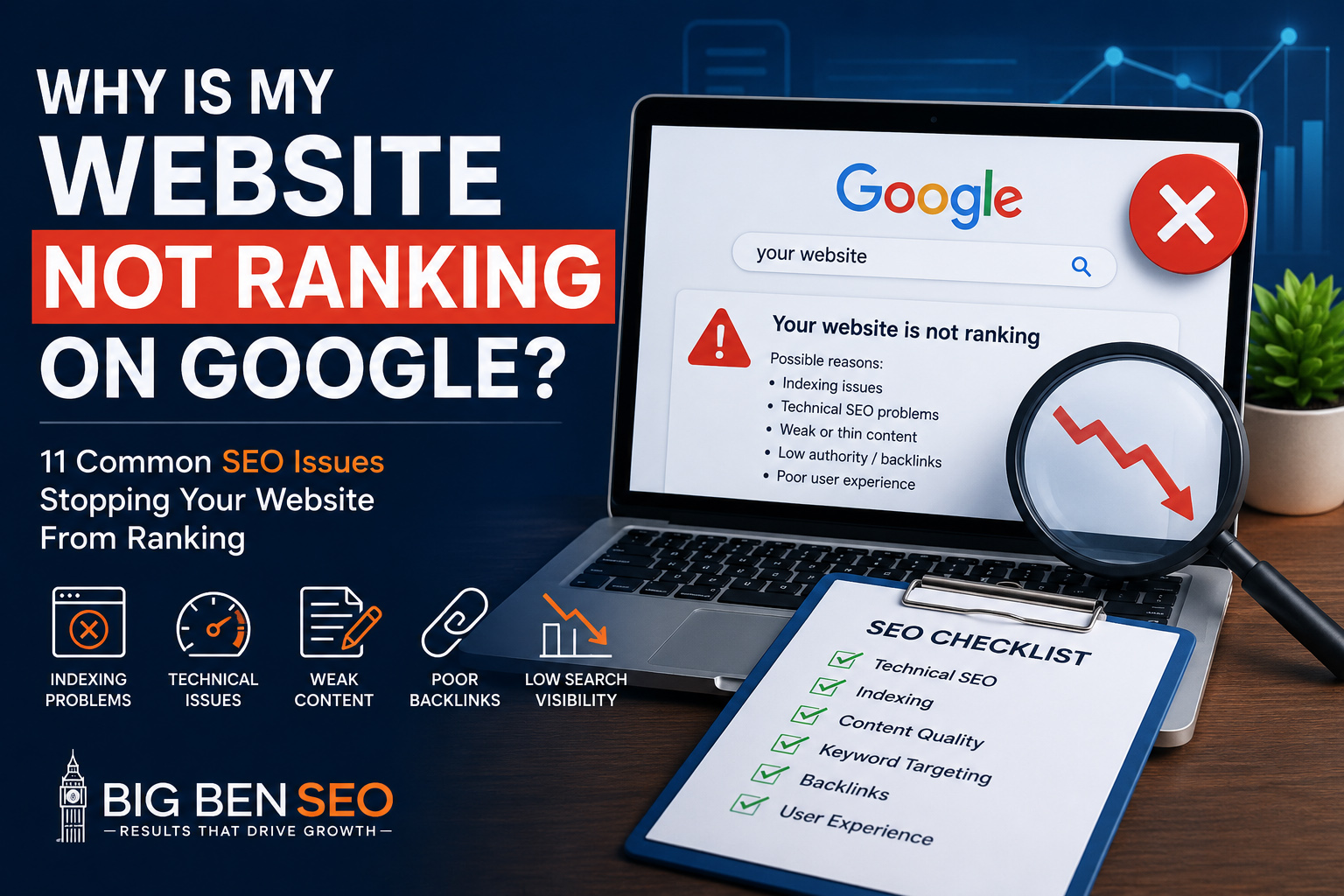
If your website is not ranking on Google, the problem is usually not one single thing. It is normally a mix of weak content, poor technical SEO, unclear keyword targeting, thin service pages, indexing problems, poor internal linking and low authority.
Many business owners keep publishing blogs, changing titles or buying backlinks without fixing the real issue. That usually wastes time.
Before spending more on SEO, you need to understand what is holding the site back.
Quick Answer: Why Your Website Is Not Ranking
Your website may not be ranking because Google cannot crawl it properly, the pages are not indexed, your content does not match search intent, your service pages are too weak, your competitors have stronger authority, or your website has technical SEO problems.
The fastest way to diagnose this is through a proper SEO audit. Big Ben SEO offers professional SEO audit services for UK businesses that identify the technical, content and keyword issues stopping your website from ranking.
1. Google Has Not Indexed Your Pages
A page cannot rank if Google has not indexed it.
This is one of the first things to check when a website is not ranking. A page may look live on your website, but that does not mean Google has added it to the index.
Common indexing problems include:
- pages blocked by robots.txt
- noindex tags added by mistake
- weak or duplicate content
- crawl issues
- poor internal linking
- canonical tags pointing to another page
- new pages not submitted in Google Search Console
Check your page in Google Search Console using URL Inspection. If the page is not indexed, fix the cause before worrying about rankings.
2. Your Page Is Targeting the Wrong Keyword
A common reason a website does not rank is poor keyword targeting.
For example, a local service page may target a broad national keyword when it should target a city-based commercial keyword. Or a blog may target a keyword that belongs on a service page.
This creates weak relevance.
A good SEO page should have:
- one clear primary keyword
- supporting secondary keywords with the same intent
- headings that match the topic
- content that answers the searcher’s real problem
- internal links to related service pages
If a page tries to target too many different keywords, Google may not understand what it should rank for.
3. Your Service Pages Are Too Thin
Many websites have service pages that are far too weak.
A thin service page usually has:
- vague introduction copy
- no clear explanation of the service
- no pricing or process signals
- no FAQs
- no proof or trust elements
- no internal links
- no location relevance
- generic text that could belong to any company
Google needs enough useful information to understand why your page deserves to rank.
For service businesses, strong service pages matter more than random blog content. If your main money pages are weak, publishing more blogs will not fix the core ranking problem.
This is why Big Ben SEO focuses on small business SEO strategy built around enquiries, not just traffic.
4. Your Content Does Not Match Search Intent
Search intent means what the user actually wants when they search.
For example:
- “SEO audit pricing” means the user wants cost information
- “SEO audit checklist” means the user wants a step-by-step list
- “SEO audit services” means the user is likely comparing providers
- “why is my website not ranking” means the user wants diagnosis
If your page does not match the intent behind the keyword, it will struggle to rank even if the keyword is included.
Do not just add keywords. Build the page around what the searcher needs to decide, understand or take action.
5. Your Website Has Technical SEO Issues
Technical SEO problems can stop good pages from ranking.
Common technical issues include:
- slow page speed
- poor mobile usability
- broken internal links
- redirect chains
- duplicate URLs
- incorrect canonicals
- poor crawl structure
- missing XML sitemap
- JavaScript rendering problems
- Core Web Vitals issues
Technical SEO is especially important if your website has many pages, location pages, ecommerce products or old URLs.
A technical audit helps separate small warnings from real ranking blockers.
6. Your Internal Linking Is Weak
Internal links help Google understand which pages are important.
If your service pages are buried, isolated or not linked from related blogs, they may struggle to rank.
A good internal linking structure should connect:
- blogs to service pages
- service pages to related service pages
- location pages to local SEO pages
- pricing pages to service pages
- audit pages to problem-aware content
For example, a blog about why a website is not ranking should link to professional SEO audit services for UK businesses because that is the natural next step.
Internal linking also helps users move from information to action.
7. Your Competitors Have Stronger Authority
Sometimes your page is good, but your competitors are stronger.
They may have:
- better backlinks
- stronger topical authority
- better service pages
- more trusted content
- stronger local signals
- more reviews
- better internal linking
- older ranking history
This does not mean you cannot compete. It means the strategy needs to be realistic.
You may need to target lower-competition keywords first, improve page quality, build supporting content and strengthen authority over time.
8. Your Website Has Duplicate or Cannibalised Pages
Keyword cannibalization happens when multiple pages compete for the same search intent.
Example:
- one page targets “SEO services London”
- another page targets “SEO agency London”
- another page targets “SEO company London”
- all three say almost the same thing
Instead of helping, this can confuse Google.
One strong page with proper keyword coverage is usually better than three weak pages fighting each other.
This is why every page should have one primary keyword and a clear role.
9. Your Website Is Not Built Around Enquiries
Ranking is not the final goal. Enquiries are.
A page may get impressions but still fail because it does not make the next step clear.
Every commercial page should explain:
- who the service is for
- what problem it solves
- what is included
- why the business is credible
- what the user should do next
If the page is vague, visitors may leave even if they find it.
SEO should connect rankings to calls, bookings, quote requests and sales conversations.
10. Your Content Is Not Structured for Google and AI Search
Search is changing. People now discover businesses through Google, AI Overviews, ChatGPT-style tools, Perplexity and other AI search experiences.
That does not mean you can force AI tools to recommend your website. No agency can guarantee that.
But you can improve your chances by making your content easier to understand.
Good Google and AI search optimisation includes:
- clear answers near the top of the page
- useful FAQs
- strong service explanations
- natural entity coverage
- comparison sections
- internal links
- specific examples
- trustworthy wording
- clean page structure
If your content is vague, thin or generic, it is less likely to perform well in both traditional search and AI-powered discovery.
11. You Have Not Given SEO Enough Time
SEO can take time, especially if your website is new, weak or in a competitive market.
Most websites need at least 3 to 6 months of consistent work before meaningful results appear. Competitive industries can take longer.
But time alone does not fix bad SEO.
If the website has poor technical setup, weak pages and no strategy, waiting six months will not magically improve rankings. You need the right work in the right order.
What To Do If Your Website Is Not Ranking
Start with diagnosis before adding more content or backlinks.
Your first steps should be:
- Check if the page is indexed
- Review the keyword and search intent
- Improve the service page content
- Fix technical SEO issues
- Add internal links from relevant pages
- Compare the page against ranking competitors
- Check Google Search Console queries
- Improve FAQs and page structure
- Strengthen authority over time
- Track rankings, clicks and enquiries
For most businesses, the best starting point is a proper SEO audit.
Big Ben SEO can review your website, identify what is blocking growth and give you a practical plan through professional SEO audit services for UK businesses.
FAQs
Why is my website not ranking on Google?
Your website may not be ranking because of indexing problems, weak content, poor keyword targeting, technical SEO issues, low authority, poor internal linking or pages that do not match search intent.
How do I know if Google has indexed my website?
Use Google Search Console and inspect the URL. If the page is not indexed, Google will show the reason. You can also search site:yourdomain.com/page-url in Google, but Search Console is more reliable.
Can a website rank without backlinks?
Yes, but it depends on the competition. Low-competition keywords can rank with strong content and good technical SEO. Competitive keywords usually need authority, backlinks and stronger topical trust.
Why is my homepage ranking but my service pages are not?
Your homepage may have more authority and internal links, while your service pages may be thin, poorly linked or weakly optimised. Service pages need clear keyword targeting, strong content, FAQs and internal links.
Will publishing more blogs help my rankings?
Only if the blogs support a clear SEO strategy. Random blogs will not fix weak service pages, indexing problems or technical SEO issues. Blogs should support money pages through topical relevance and internal links.
How long does it take for a website to rank?
Most SEO campaigns need 3 to 6 months to show meaningful progress. Some improvements can happen faster if the site already has authority and the issues are easy to fix.
What is the fastest way to find SEO problems?
The fastest way is to run a proper SEO audit. A good audit checks technical SEO, indexation, content quality, keyword targeting, internal links, competitors and ranking opportunities.
Can AI search affect my SEO strategy?
Yes. Content should now be structured for both Google and AI-powered search experiences. Clear answers, FAQs, strong internal links and trustworthy service information can improve how easily search engines and AI systems understand your website.
Should I hire an SEO audit consultant?
An SEO audit consultant is useful if you want to understand what is actually holding your website back before spending more on SEO. Tools can show errors, but a consultant helps prioritise what matters commercially.
What should I fix first if my website is not ranking?
Fix indexation problems, technical blockers, weak service pages, missing internal links and poor keyword targeting first. These usually have more impact than publishing more blog content.
You may also find useful: Website Speed and SEO: Why Slow Sites Lose Rankings and Leads and SEO Audit Checklist for UK Businesses.

Written by
Ammar Rafique, Founder
Ammar started Big Ben SEO in 2019 to give small and medium sized UK businesses honest, practical SEO with clear priorities and reports that show what changed.
About Ammar · LinkedIn