


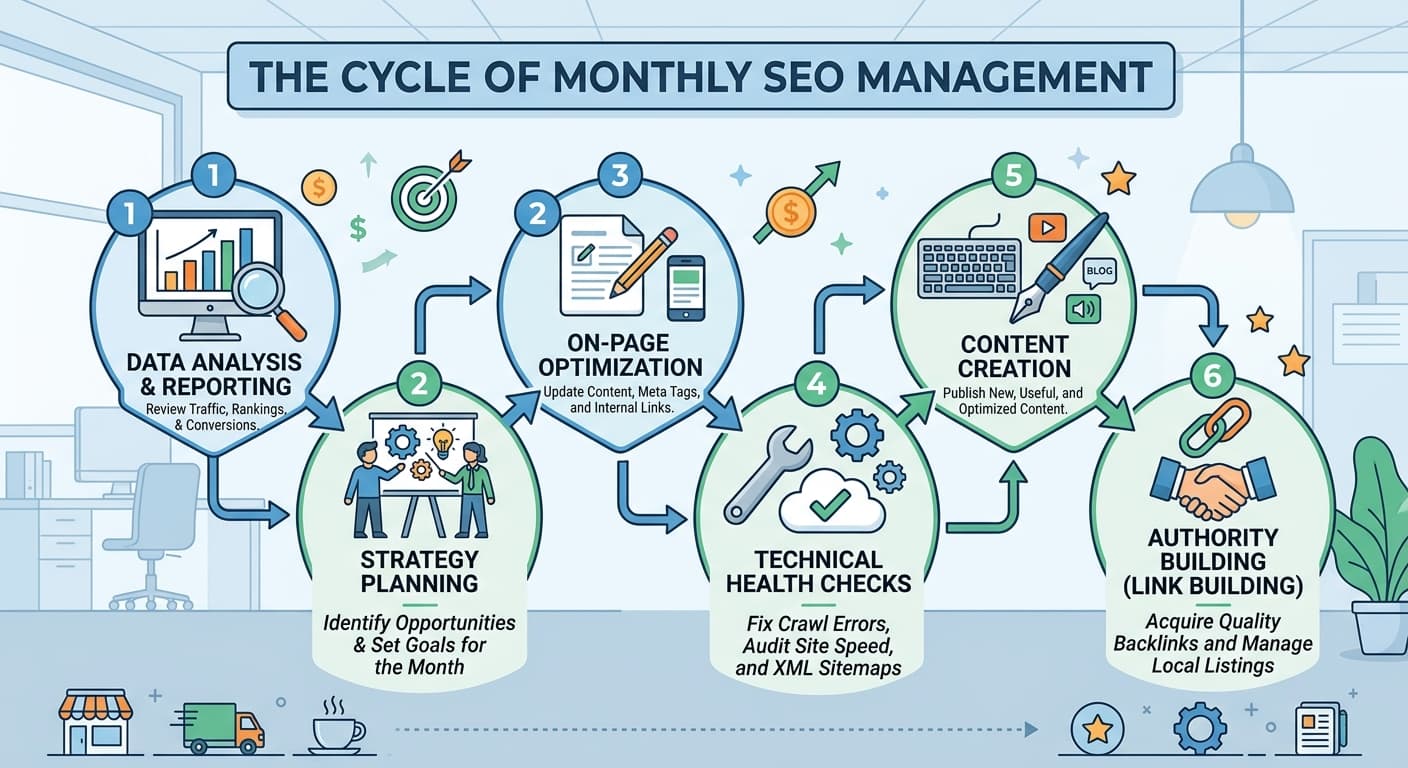
Monthly SEO management involves continuously reviewing, improving and expanding a website’s organic search presence. It is not simply a matter of adding keywords or publishing a fixed number of blog posts every month.
A suitable monthly strategy may include technical checks, keyword analysis, content improvements, internal linking, local SEO, authority building and performance reporting. The exact priorities should depend on the website’s condition, current rankings, competition and business objectives.
This guide explains what happens during monthly SEO management, why the work changes over time and what a small business should expect from an ongoing campaign.
Why Does SEO Require Monthly Management?
SEO is not a one-time website adjustment. Search results, competitors, customer behaviour and the website itself can all change.
A page that performs well today may lose visibility if:
- Competitors publish more useful content
- The information becomes outdated
- Search intent changes
- Internal links are removed or altered
- Technical problems prevent proper crawling
- Another page begins competing for the same keyword
- The business changes its products or services
- Google reassesses which results are most useful
Monthly SEO management provides an opportunity to identify these changes and respond before they develop into larger problems.
It also allows the campaign to build gradually. Initial work may concentrate on correcting technical issues and improving essential service pages. Later activity can expand the website’s coverage, strengthen internal links and improve pages already approaching valuable search positions.
Businesses looking for this continuing support can review our monthly SEO services.
What Happens in the First Month of SEO?
The first month is usually different from later months because the SEO provider must understand the website before making significant changes.
Initial work may include:
- Reviewing the business and its target customers
- Identifying important products or services
- Checking the locations the business serves
- Analysing existing rankings and organic traffic
- Reviewing Google Search Console and analytics data
- Crawling the website for technical problems
- Examining page titles, headings and content
- Reviewing competing websites
- Mapping keywords to appropriate pages
- Checking whether multiple pages target the same intent
- Establishing conversion tracking
- Creating an initial list of priorities
This discovery stage helps prevent random activity.
For example, creating new pages would be premature if suitable pages already exist but are poorly optimised. Rewriting a page would also be risky if another URL currently receives most of the impressions for its target keyword.
The first month should therefore produce a clearer understanding of what the website needs and which actions are most likely to support its commercial objectives.
What Happens During Ongoing Monthly SEO?
Once the initial review is complete, monthly SEO becomes an ongoing cycle of analysis, implementation and measurement.
The work will normally fall into several areas.
1. Search Performance Is Reviewed
Monthly management should begin with evidence rather than assumptions.
The SEO provider may review:
- Organic clicks
- Search impressions
- Average keyword positions
- Click-through rates
- Landing-page performance
- Conversions from organic visitors
- New queries appearing in search results
- Pages gaining or losing visibility
- Differences between mobile and desktop performance
Google Search Console can show which queries produce impressions for each page. This is useful for identifying pages that are close to stronger positions or appearing for unintended keywords.
Analytics and conversion data can then show what visitors do after arriving on the website.
Traffic growth alone is not enough. A campaign should consider whether organic visitors are becoming enquiries, bookings or customers.
2. Priorities Are Adjusted
A monthly SEO campaign should not blindly repeat the same tasks regardless of performance.
Priorities may change because:
- A page begins moving towards page one
- A valuable keyword starts producing more impressions
- A competitor publishes a stronger page
- A technical problem appears
- A service becomes more commercially important
- A new location is introduced
- Two pages begin competing for the same search intent
- A recent content update performs better or worse than expected
One month may require extensive technical corrections. Another may focus on improving a commercially important page that has reached the second page of Google.
This flexibility is one reason businesses should examine the strategy behind a service rather than judging it only by the number of tasks listed. Our overview of SEO packages for small businesses explains what to consider when comparing different levels of support.
3. Technical SEO Issues Are Checked
Technical SEO helps search engines access, understand and process a website.
Monthly technical work may include checking:
- Indexing problems
- Broken internal links
- Redirect errors
- Missing or incorrect canonical tags
- Duplicate pages
- XML sitemap issues
- Robots.txt instructions
- Mobile usability
- Page-loading problems
- Structured data errors
- Changes caused by plugins or website updates
- Pages returning incorrect status codes
Not every website requires major technical work every month. A small local business website may need occasional maintenance, while a large ecommerce website with frequently changing products may require much closer monitoring.
The purpose is not to manufacture technical tasks. It is to identify problems that could prevent important pages from being crawled, indexed or used effectively.
4. Existing Pages Are Improved
Creating new content is only one part of SEO. Improving existing pages can sometimes offer a clearer opportunity.
Monthly on-page work may involve:
- Refining page titles
- Improving meta descriptions
- Clarifying headings
- Strengthening introductions
- Expanding incomplete service information
- Removing irrelevant content
- Improving calls to action
- Adding useful internal links
- Matching the page more closely to search intent
- Reducing repetition
- Correcting outdated information
Search data can reveal whether Google already associates a page with its intended keyword.
If a page receives substantial impressions but ranks outside the strongest results, it may need better relevance, stronger supporting content, improved internal links or greater authority. It does not necessarily need to be replaced.
Existing pages should be updated carefully. Changing titles, headings and main keywords without reviewing current performance can damage developing visibility.
5. Keyword Ownership Is Monitored
Each important page should have a clear purpose.
For example:
- The homepage may target the company’s broad primary service
- A service page may target one specific commercial service
- A location page may target a service in a defined area
- A blog may answer an informational question
- A pricing page may address cost-related intent
Problems occur when several pages try to rank for the same keyword without serving meaningfully different purposes.
This can make it difficult for search engines to determine which page should appear. It may also divide internal links and external authority between competing URLs.
Monthly SEO management should therefore monitor:
- Which page ranks for each important keyword
- Whether an unintended page receives impressions
- Whether two URLs repeatedly exchange positions
- Whether a new article overlaps with a service page
- Whether weak or duplicate pages should be consolidated
- Whether internal links point towards the correct destination
Keyword ownership should be established before making major content changes.
6. New Content Is Planned and Created
New content may be required when the website does not adequately cover a relevant service, location, problem or customer question.
Depending on the strategy, this could include:
- Service pages
- Industry pages
- Location pages
- Product-category content
- Comparison articles
- Guides
- Frequently asked questions
- Case studies
- Supporting blog articles
Content should not be published merely to meet a monthly word count.
Each new page should have:
- A defined primary keyword
- A clear search intent
- A specific place within the site structure
- A relevant parent page
- Useful internal links
- A reason for existing
A supporting blog should help users while strengthening the topic covered by its parent service page. It should not unintentionally replace or compete with that commercial page.
7. Internal Links Are Improved
Internal links help visitors and search engines move between related pages.
Monthly internal-link work can include:
- Linking blogs to relevant service pages
- Linking service pages to supporting information
- Adding links from established pages to newer content
- Fixing broken links
- Updating links that point to redirected URLs
- Improving unclear anchor text
- Strengthening important pages that are buried within the site
For example, an article discussing monthly SEO activity should direct readers towards the main monthly service page. Supporting references to packages, pricing and broader small-business services may also be appropriate when they genuinely help the reader.
Internal links should follow the relationship between topics rather than being inserted randomly.
8. Local SEO Signals Are Managed
For businesses serving particular towns, cities or regions, monthly SEO may include local-search activity.
This can involve:
- Updating the Google Business Profile
- Reviewing business categories
- Checking contact and location information
- Publishing relevant profile updates
- Adding genuine business photographs
- Responding to customer reviews
- Monitoring duplicate listings
- Checking business citations
- Improving local landing pages
- Reviewing location-based queries
Local SEO should accurately reflect the real business.
Creating large numbers of nearly identical city pages or inserting place names unnaturally across the website can produce poor-quality pages. A location page should provide information that is genuinely relevant to customers in that area.
9. Website Authority Is Developed
Google may consider references and links from other websites when evaluating a page’s prominence and credibility.
Monthly authority work may include:
- Identifying relevant industry directories
- Correcting inaccurate business listings
- Creating useful resources that can attract references
- Digital public relations
- Supplier or professional-association links
- Local business citations
- Relevant guest contributions
- Recovering valuable broken links
Quality matters more than simply accumulating large numbers of links.
Links from irrelevant, automated or low-quality websites may provide little value and can create unnecessary risk. Authority building should focus on genuine relevance and trust rather than headline quantities.
10. Competitors Are Monitored
Competitor analysis is not limited to the beginning of a campaign.
Monthly reviews may examine:
- New competitor pages
- Changes in search positions
- Topics competitors cover
- Their internal site structure
- Links they have earned
- Search-result features they occupy
- Content formats appearing prominently
- Gaps in their information
The objective is not to copy competitors.
A competing page may rank because of its established authority rather than its wording or design. Replicating that page will not necessarily reproduce its performance.
Competitor research should help identify expectations, opportunities and weaknesses while allowing the business to create something more useful and distinctive.
11. Conversions and User Experience Are Considered
SEO should attract relevant visitors, but the website must also help those visitors take the next step.
Monthly reviews may identify problems such as:
- Unclear calls to action
- Difficult contact forms
- Missing telephone links on mobile
- Confusing service descriptions
- Poor navigation
- Distracting page layouts
- Important information placed too far down the page
- Slow or unstable mobile pages
- Inconsistent contact details
Conversion improvements are especially important for small businesses because commercial results matter more than traffic alone.
A page generating 100 relevant visits and several qualified enquiries may be more valuable than a blog generating thousands of visits from people who will never become customers.
12. Monthly SEO Reporting Is Provided
Reporting should explain more than whether rankings increased or decreased.
A useful monthly report may cover:
- Work completed
- Organic clicks and impressions
- Important ranking changes
- Landing-page performance
- Conversions or enquiries
- Technical issues identified
- Content published or updated
- Links or citations developed
- Current observations
- Priorities for the following month
The report should connect activity with the wider strategy.
For example, it should explain why a particular page was improved, what search data supported that decision and what will be monitored next.
Ranking snapshots can be helpful, but they should not be viewed in isolation. Positions vary by location, device and search context.
Does the Same SEO Work Happen Every Month?
No. A credible monthly campaign should adapt to the website’s needs.
It would be unusual for every site to require the same number of technical fixes, articles, links and page updates every month.
A campaign could develop as follows:
Month One
- Website and competitor review
- Keyword mapping
- Technical audit
- Analytics and Search Console checks
- Initial strategy
Month Two
- Technical corrections
- Improvements to priority pages
- Internal-link restructuring
- Conversion tracking adjustments
Month Three
- Supporting content
- Local SEO improvements
- Authority development
- Review of early performance changes
Later Months
- Expansion into new opportunities
- Updates to pages gaining impressions
- Consolidation of overlapping content
- Continued authority building
- Conversion improvements
- Strategy adjustments based on results
This is only an example. Actual priorities should be based on evidence rather than an identical schedule applied to every website.
What Should Not Be Expected From Monthly SEO?
Businesses should be cautious about unrealistic expectations.
Monthly SEO cannot legitimately guarantee:
- A specific number-one ranking
- Immediate organic traffic
- A fixed number of customers
- Permanent rankings
- Control over Google updates
- Identical progress every month
It should also not require unnecessary changes merely to make a report appear busy.
For example, repeatedly rewriting a page that is already developing visibility can interrupt progress. Publishing irrelevant articles can dilute the website’s topical focus. Building low-quality links to meet a monthly quota can create risk without meaningful value.
The work should have a clear reason connected to search performance or business goals.
How Long Should Monthly SEO Continue?
There is no universal campaign length because websites begin from different positions and compete in different markets.
A small established website targeting a low-competition local service may progress more quickly than a new website entering a competitive national industry.
SEO also changes after initial targets are reached.
The campaign may move from:
- Correcting problems to expanding visibility
- Creating pages to improving conversions
- Pursuing initial rankings to defending established positions
- Building basic relevance to strengthening authority
- Tracking traffic to improving lead quality
Businesses should evaluate SEO according to meaningful trends and commercial outcomes rather than expecting every month to produce the same increase.
How Much Does Monthly SEO Management Cost?
The cost depends on the amount and complexity of the work required.
Factors can include:
- Website size
- Technical condition
- Number of services
- Target locations
- Level of competition
- Content requirements
- Authority building
- Ecommerce functionality
- Reporting requirements
- Current organic visibility
A small local website will not usually require the same resources as a national ecommerce store. Our guide to SEO pricing in the UK explains the factors that can influence the cost.
The cheapest service is not necessarily the most affordable in practice. A low-cost campaign that performs irrelevant tasks or creates poor-quality content can waste more money than a focused service with a higher monthly fee.
How to Evaluate a Monthly SEO Service
Before selecting a provider, ask:
- How will priorities be chosen?
- Will existing search data be reviewed?
- How are keywords assigned to pages?
- How will conversions be tracked?
- What happens if priorities change?
- Will reports explain completed work?
- How are new pages prevented from competing with existing ones?
- What types of links will be pursued?
- Who approves important website changes?
- Are results or rankings being guaranteed?
A suitable provider should be able to explain why each activity is relevant to the business.
Small companies needing broader support can also explore our small business SEO service.
Is Monthly SEO Management Worth It?
Monthly SEO management can be worthwhile when potential customers use search engines to find the business’s services and the campaign is focused on commercially relevant outcomes.
Its value comes from sustained improvement rather than the repetition of a fixed checklist.
A well-managed campaign should:
- Identify the website’s strongest opportunities
- Correct problems that restrict visibility
- Improve important commercial pages
- Develop useful supporting content
- Strengthen internal connections
- Monitor page ownership
- Build relevant authority
- Measure enquiries and conversions
- Adapt according to performance
The business should understand what is being done, why it matters and what the next priorities are.
For ongoing support built around your website’s actual requirements, learn more about our monthly SEO services.
Frequently Asked Questions
What Happens During Monthly SEO?
Monthly SEO normally includes performance analysis, technical checks, page improvements, content planning, internal linking, local optimisation, authority development and reporting. The precise work should change according to the website’s priorities.
Does SEO Need to Be Done Every Month?
SEO benefits from regular management because competitors, search results, website content and customer behaviour change. Not every task needs to be completed monthly, but performance and technical health should be reviewed consistently.
How Many Hours of SEO Does a Small Business Need Each Month?
There is no fixed number suitable for every business. The required time depends on the website’s size, condition, competition, target locations and content needs.
Should an SEO Agency Publish Blogs Every Month?
Only when the planned articles serve a relevant search need and support the website’s wider structure. Publishing blogs simply to meet a quota can produce thin, overlapping or commercially irrelevant content.
Should SEO Reports Be Provided Monthly?
Monthly reporting is useful because it records completed work, performance changes, developing opportunities and upcoming priorities. Reports should include meaningful context rather than presenting rankings without explanation.
Why Do Monthly SEO Tasks Change?
Tasks change because the website and search environment change. A technical issue may become urgent, a page may approach page one or new search data may reveal a better opportunity. The strategy should respond accordingly.