


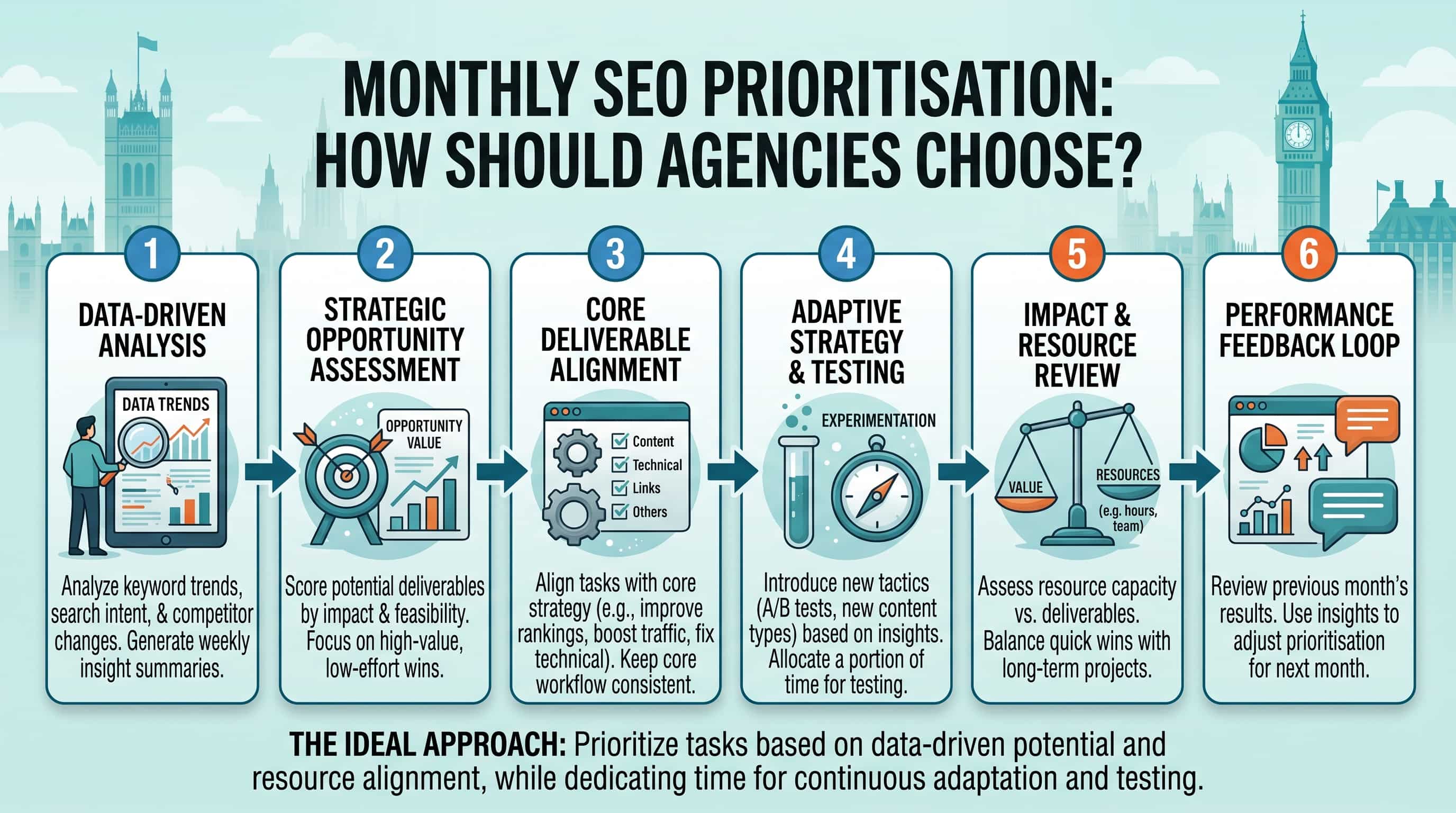
Monthly SEO prioritisation should begin with evidence, not an unchanging list of tasks. An agency should review business objectives, search performance, technical health, commercial-page opportunities and work already completed before deciding what needs attention next.
The highest priority is not necessarily the task that is easiest to complete. It should be the work most likely to remove an important obstacle, improve a commercially valuable page or support a genuine business objective.
One month may require technical corrections. Another may focus on improving service pages, consolidating competing content, strengthening internal links or building authority. The priorities should change as the website and available evidence change.
Direct Answer
An agency should choose next month’s SEO priorities by answering six questions:
- What are the business’s most important commercial goals?
- What has changed in organic search performance?
- What is currently preventing further progress?
- Which pages or queries present the strongest opportunities?
- What work is likely to produce the greatest useful impact?
- What can realistically be completed with the available resources?
The agency should then document:
- The selected priorities
- The evidence behind each decision
- The work required
- Who is responsible
- Any dependencies or approvals
- How the result will be evaluated
This creates a clear monthly plan without forcing every campaign to repeat the same deliverables.
What Is Monthly SEO Prioritisation?
Monthly SEO prioritisation is the process of deciding which SEO activities should receive attention during the next campaign period.
Potential activities might include:
- Correcting crawling or indexing problems
- Improving commercial landing pages
- Updating declining content
- Consolidating overlapping pages
- Creating supporting content
- Strengthening internal links
- Improving local visibility
- Acquiring relevant links
- Correcting tracking problems
- Improving organic conversion pathways
- Supporting a new service, product or location
Most websites have more possible tasks than can be completed during a single month. Prioritisation determines which of those tasks matter most now.
It is therefore different from producing a general SEO checklist. A checklist identifies possible activities. Prioritisation decides which activities deserve the available time and budget.
Why SEO Priorities Should Not Be Chosen in Advance for the Entire Year
An agency can establish long-term objectives and a broad roadmap, but it should not rigidly determine every monthly task before seeing how the website performs.
Conditions can change because of:
- New search-performance data
- Changes in demand
- New competitors
- A website redesign
- A migration
- Products or services being added
- Changes to business priorities
- Content gaining or losing visibility
- Technical problems emerging
- Previous work performing differently from expectations
A twelve-month strategy may remain valid while the order of individual tasks changes.
For example, an agency may plan to create supporting content during the second month. If an important section of the website suddenly becomes excluded from Google’s index, resolving that problem should usually take priority.
Planning provides direction. Prioritisation allows the campaign to respond to evidence.
Start With Commercial Objectives
SEO priorities should begin with what the business is trying to achieve.
Relevant objectives may include:
- Generating enquiries for a particular service
- Increasing sales in an important product category
- Expanding into a genuine new location
- Attracting a more profitable customer type
- Reducing dependence on paid advertising
- Supporting a seasonal service
- Improving bookings at an underused location
- Launching a new product or service
- Increasing qualified organic leads
The agency should identify which pages and searches are connected with those objectives.
This prevents the campaign from focusing exclusively on traffic volume. A high-volume informational keyword may attract many visitors without supporting a valuable business action. A lower-volume commercial search may be more important if it brings prospective customers to a relevant service page.
The first prioritisation question should therefore be:
If this work succeeds, which business objective will it support?
If the answer is unclear, the task may not deserve immediate priority.
Review What Happened During the Current Month
The next plan should not be created without evaluating the current one.
The agency should review:
- Work completed
- Work delayed or awaiting approval
- Pages changed
- Content published
- Technical problems corrected
- Links acquired
- Search visibility changes
- Organic conversions
- Unexpected results
- Lessons that affect the next plan
This review should distinguish between completed work and measurable results.
Some SEO changes require time before their effect becomes clear. The agency should not abandon a page improvement simply because rankings did not change within a few days. However, it should confirm that the work was implemented correctly, the page remains indexable and the intended search purpose is clear.
The review may also uncover unfinished dependencies. For example, a technical recommendation may have been produced but not implemented because development access or client approval was unavailable. That unresolved issue may need to remain a priority.
Use Search Console to Identify Changes and Opportunities
Google Search Console should be one of the main evidence sources used during monthly SEO prioritisation.
Its performance reporting allows an agency to examine:
- Clicks
- Impressions
- Click-through rates
- Average positions
- Queries
- Pages
- Countries
- Devices
- Changes over time
Google recommends monitoring performance trends and investigating traffic changes to help prioritise SEO work. Google’s Search Console guidance
The agency should look beyond the overall totals. Sitewide performance can hide meaningful changes affecting individual services or pages.
Pages with increasing impressions
A page gaining relevant impressions may have the potential to reach more searchers.
The agency should examine:
- Whether the page satisfies the intended search
- Its current ranking range
- The queries generating impressions
- Whether those queries are commercially relevant
- Whether important information is missing
- Its internal-link support
- Its title and search appearance
- Whether another page competes for the same intent
An existing page showing clear demand may deserve attention before a completely new page is created.
Pages with declining clicks
A decline should be investigated before a solution is selected.
Possible causes include:
- Ranking losses
- Reduced search demand
- Changes to search-result layouts
- Competitor improvements
- Technical problems
- Content becoming outdated
- Search-intent changes
- Another page replacing the intended URL
- A lower click-through rate
The response depends on the cause. Updating content will not solve an indexing problem, and acquiring links may not solve intent mismatch.
High impressions with few clicks
A page receiving substantial impressions but few clicks may require investigation.
The agency should review:
- Average position
- Query relevance
- SEO title
- Meta description
- competing search results
- Brand recognition
- Search intent
- Whether the wrong page is ranking
A low click-through rate does not automatically mean the title needs rewriting. If the page is appearing near the bottom of the results, ranking position may explain the limited clicks.
Search Console’s performance report provides clicks, impressions, CTR and average position, but these metrics must be interpreted together rather than in isolation. Google’s Performance report documentation
Queries close to stronger visibility
Relevant queries ranking near the first page can reveal useful opportunities.
Before prioritising them, confirm that:
- The query has genuine commercial or strategic value
- The correct page is ranking
- The page closely matches the intent
- Improvements can be made without creating another overlapping URL
- The opportunity is substantial enough to justify the resources
Not every query ranking between positions 11 and 20 is automatically a quick win. Relevance and business value still matter.
Identify the Website’s Current Limiting Factor
The most important monthly SEO priority is often the factor preventing progress.
Common limiting factors include:
- Important pages are not indexed
- Commercial pages do not satisfy search intent
- Multiple URLs compete for the same queries
- The website lacks authority
- Important pages receive insufficient internal-link support
- Content does not demonstrate adequate expertise
- Local signals are weak or inconsistent
- Organic visitors do not convert
- Tracking is incomplete
- The website has serious performance or usability problems
The agency should avoid distributing effort equally across technical SEO, content, links and local SEO simply to create a balanced report.
If an important section cannot be crawled or indexed, producing more content may increase the number of affected pages without solving the underlying problem.
If the technical foundation is healthy but competitors have substantially stronger authority, repeatedly conducting technical audits may not move the campaign forward.
Priorities should concentrate resources on the most important constraint.
Evaluate Technical Risk Before Growth Opportunities
Critical technical problems should normally take precedence when they threaten crawling, indexing, website access or measurement.
Urgent examples may include:
- Important pages carrying a noindex directive
- Incorrect canonical tags
- Broken redirects following a migration
- Server errors
- Important sections blocked in robots.txt
- Mobile pages missing essential content
- Incorrect tracking after a website change
- Widespread broken internal links
- A compromised or hacked website
Not every technical warning is urgent.
SEO tools can produce extensive lists of issues, but those issues vary greatly in importance. The agency should assess:
- How many important pages are affected
- Whether Google can crawl and index them
- Whether the issue influences users
- Whether it affects commercial pages
- Whether fixing it is likely to change performance
- The time and development resources required
A minor warning affecting an unimportant archived page should not automatically outrank an opportunity on a commercially valuable service page.
Compare Impact, Confidence and Effort
A practical prioritisation model can evaluate each proposed task using three factors.
Impact
How valuable could the result be?
Consider:
- Commercial importance
- Number of affected pages
- Existing search demand
- Current impressions
- Potential effect on enquiries or sales
- Strategic importance to the business
- Risk of leaving the problem unresolved
Confidence
How strong is the evidence that the work will help?
Confidence may be higher when:
- Search Console already shows relevant demand
- The correct page ranks within reach
- A clear technical problem has been confirmed
- Competing pages have been identified
- The recommended change directly addresses intent
- Conversion data reveals a specific weakness
Confidence may be lower when the task is based only on a tool recommendation or a competitor copying exercise.
Effort
What is required to complete the work properly?
Consider:
- Research
- Writing
- Design
- Development
- Client review
- Specialist input
- Outreach
- Implementation time
- Dependencies
- Approval delays
The goal is not always to select the easiest tasks. A high-effort technical correction may be essential. However, comparing effort prevents a month’s capacity from being consumed by work with limited likely value.
A Simple Monthly SEO Prioritisation Table
An agency can document proposed work using a table like this:
| Proposed task | Evidence | Potential impact | Confidence | Effort | Decision |
|---|---|---|---|---|---|
| Improve a service page | Relevant impressions at positions 12–18 | High | High | Medium | Prioritise |
| Publish a new article | Supports an important service-page gap | Medium | Medium | Medium | Schedule |
| Correct canonical errors | Important pages point to the wrong URLs | High | High | Low | Urgent |
| Rewrite every meta description | No page-level CTR evidence | Low | Low | High | Defer |
| Acquire relevant links | Authority gap against ranking competitors | High | Medium | High | Begin outreach |
| Add another location page | No genuine presence or service evidence | Low | Low | Medium | Reject |
The scores do not need to be mathematically precise. Their purpose is to make the reasoning visible and prevent tasks from being selected arbitrarily.
Prioritise Existing Pages Before Creating Unnecessary New Ones
New content is not always the best monthly priority.
Existing pages may already:
- Receive relevant impressions
- Rank on pages two or three
- Have acquired links
- Cover most of the required subject
- Support an important service
- Compete with another page
- Need relatively focused improvements
In these cases, updating or consolidating existing content may be more useful than publishing another URL.
Before approving a new page, the agency should ask:
- Does a current page already target this intent?
- Could the existing page be expanded?
- Would the proposed page have a distinct purpose?
- Which commercial page would it support?
- How would it fit within the internal-link structure?
- Does the business have useful expertise to contribute?
- Is there evidence of relevant search demand?
- Could the new page create cannibalisation?
A publishing target should not override these checks.
Give Commercial Pages Appropriate Attention
Blogs often appear prominently in monthly deliverable reports because they are easy to count. However, the website’s service, product, category and location pages are usually more closely connected with revenue.
Commercial-page work may deserve priority when:
- The page ranks for relevant searches but remains outside the strongest positions
- The wrong page appears for an important query
- The content does not answer buyer questions
- The service description is unclear
- Trust information is missing
- Internal links are weak
- The page has visibility but generates few enquiries
- Several commercial pages overlap
- Competitors provide more complete decision-making information
Improving one commercially important page may create more value than publishing several disconnected articles.
Account for Dependencies and Available Resources
A priority cannot always be completed immediately.
Dependencies may include:
- Client approval
- Developer availability
- Access credentials
- Legal review
- Medical or technical expert review
- New photography
- Pricing decisions
- Analytics configuration
- Information from another department
The monthly plan should distinguish between:
- Work the agency can complete directly
- Work requiring client input
- Recommendations awaiting approval
- Development tasks assigned to another party
- Longer-term work already underway
If a high-impact task is blocked, the agency should record the blocker and select the next best unblocked activity. It should not quietly replace the task without explaining why.
Balance Urgent Work With Long-Term Progress
Monthly SEO prioritisation should not become entirely reactive.
Urgent problems need attention, but the agency should also maintain progress towards longer-term objectives such as:
- Building topical coverage
- Improving important commercial sections
- Earning authority
- Strengthening local visibility
- Developing useful resources
- Improving conversion pathways
- Reducing content overlap
- Preparing for seasonal demand
A sensible monthly plan may contain:
- One urgent corrective priority
- One commercial growth priority
- One supporting or longer-term priority
- Consistent monitoring and reporting
The exact balance should depend on the website, not on a universal formula.
How Should Agencies Handle Stakeholder Requests?
Clients and internal teams may request tasks that are not supported by SEO evidence.
Examples include:
- Creating a page for every nearby town
- Targeting a high-volume but irrelevant keyword
- Copying every competitor article
- Publishing a fixed number of blogs
- Changing a page that has only recently been improved
- Adding keywords repeatedly to existing copy
- Creating separate pages for minor keyword variations
The agency should evaluate the request rather than accepting or rejecting it automatically.
A useful response should explain:
- What the request is intended to achieve
- Whether evidence supports it
- Any cannibalisation or quality risks
- The resources required
- How it compares with existing priorities
- A safer or more valuable alternative
Prioritisation does not mean ignoring stakeholders. It means making the trade-offs clear.
When Should Priorities Be Changed During the Month?
Priorities should not change every time a ranking moves. Frequent changes can leave important work unfinished.
However, an agency may need to adjust the plan when:
- A serious indexing problem appears
- The website becomes unavailable
- Tracking stops working
- A migration creates unexpected errors
- A major business priority changes
- An important product or service is withdrawn
- Google issues a manual action
- A security problem affects the website
- Required approval makes the original task impossible
- New evidence materially changes the original decision
Routine ranking fluctuations should normally be monitored and interpreted in context rather than triggering immediate changes.
How Should Selected Priorities Be Reported?
A monthly plan should explain why each priority was selected.
For every substantial activity, the agency should document:
- The problem or opportunity
- Supporting evidence
- The affected page or website section
- The proposed work
- The expected direction of improvement
- Required approvals
- Responsible parties
- The evaluation method
- The likely review period
For example:
Priority: Improve the monthly SEO services page.
Evidence: The page receives consistent impressions for commercially relevant searches but ranks mainly outside the first page. Supporting content exists, but the service page needs clearer differentiation and stronger internal-link support.
Work: Improve the page’s service explanation, deliverables, decision-making information and internal links from relevant supporting articles.
Evaluation: Monitor query relevance, impressions, average positions, clicks and qualified enquiries over an appropriate period.
This is more useful than reporting that a page was “optimised” without explaining the reason.
Businesses reviewing campaign performance may also find it helpful to understand what a monthly SEO report should include.
Common Monthly Prioritisation Mistakes
An agency should avoid:
- Repeating the same tasks without reviewing their value
- Selecting work only because it is easy to report
- Prioritising traffic without considering commercial relevance
- Creating new pages before checking existing content
- Treating every technical warning as equally urgent
- Copying competitors without understanding search intent
- Ignoring conversion data
- Reacting to short-term ranking fluctuations
- Starting more work than can be completed
- Leaving dependencies undocumented
- Changing priorities without explaining why
- Measuring every task over the same timeframe
- Allowing content quantity to replace strategic judgment
Good prioritisation requires decisions, including decisions about what should not be done yet.
How Does Prioritisation Affect Monthly Deliverables?
Priorities determine the implementation work that appears in the next month’s deliverables.
Certain activities should remain consistent, including:
- Performance monitoring
- Technical oversight
- Reporting
- Communication
- Review of completed work
- Planning
However, implementation should respond to the website’s current needs.
This is why monthly SEO deliverables should not remain exactly the same. Consistency should come from the decision-making process and accountability, not from repeating an identical task list.
Questions Clients Can Ask About Next Month’s Priorities
A client can ask:
- Why were these priorities selected?
- Which data supports each decision?
- How do they connect with our business objectives?
- What other tasks were considered?
- Why were those tasks deferred?
- Are any important activities blocked?
- What input or approval do you need from us?
- Which pages will be affected?
- How will the work be evaluated?
- When should we expect enough evidence to review the result?
- What circumstances could change the plan?
- How does this work support the longer-term strategy?
An agency should be able to explain the reasoning without relying on vague claims about algorithms or activity volume.
Final Answer
An agency should choose next month’s SEO priorities by combining commercial objectives with current evidence.
The process should review:
- Business priorities
- Search Console and analytics data
- Technical risks
- Commercial-page performance
- Content gaps and overlaps
- Internal-link structure
- Authority requirements
- Conversion performance
- Available resources
- Outstanding dependencies
- Work completed during the current month
Potential activities should then be compared according to their likely impact, the confidence behind the recommendation and the effort required.
The selected work should address the website’s most important current limitation or opportunity. It should not be chosen merely because it appears in a fixed package or produces an easy deliverable count.
Businesses looking for an evidence-led campaign can explore Big Ben SEO’s monthly SEO services. Monthly work should follow a consistent strategic process while adapting to the website’s performance and commercial priorities.
You may also find useful: Should Monthly SEO Deliverables Stay the Same Every Month? and What Should a Monthly SEO Report Include?.