


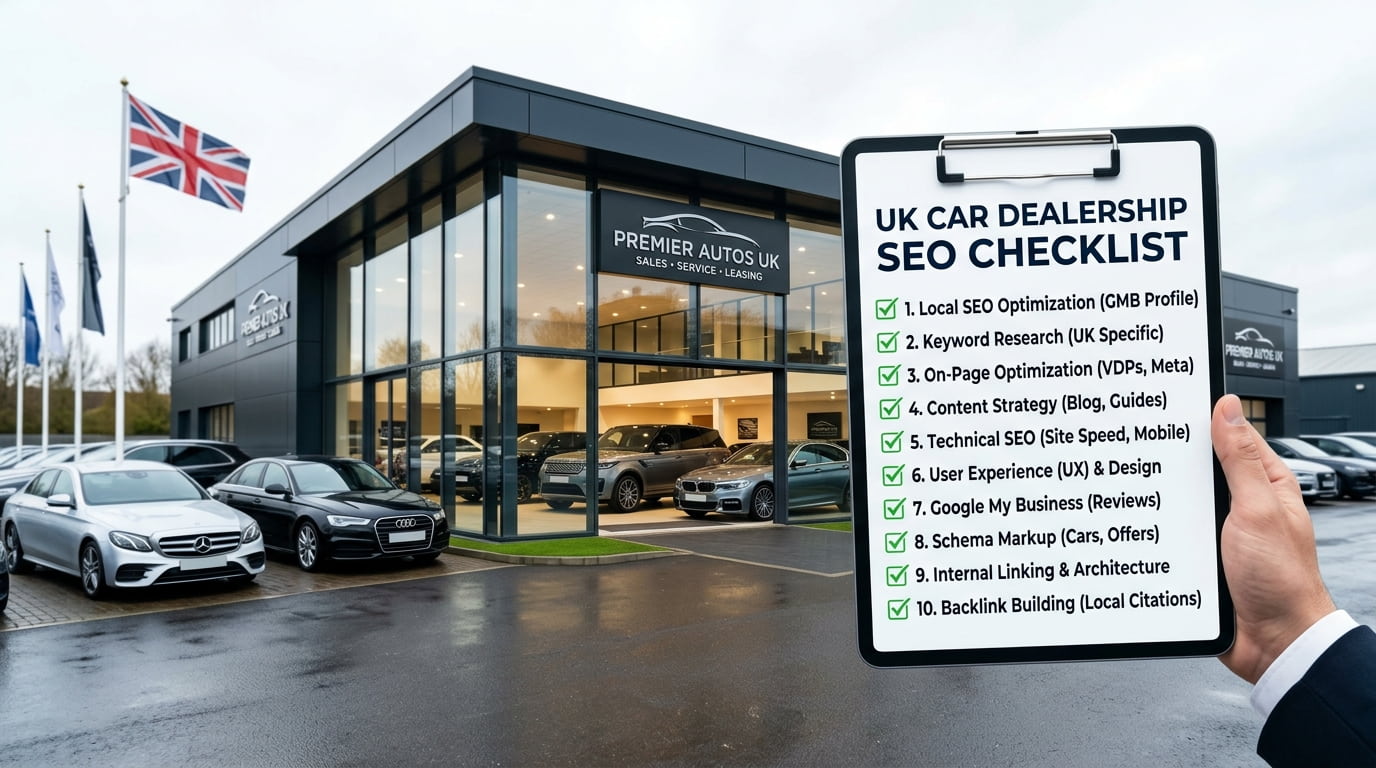
A dealership website may contain hundreds or thousands of vehicle listings, but having more pages does not automatically produce greater search visibility.
Poor website structure, expired stock pages, duplicate descriptions, unhelpful filters and weak location signals can prevent important pages from ranking. Even when visitors reach the website, confusing navigation or enquiry forms can stop them from contacting the dealership.
This car dealership SEO checklist will help UK dealers review the technical, content, local and conversion elements that influence organic performance.
1. Confirm Which Searches Each Page Should Target
Every important page should have one clear purpose.
A dealership website may need to target searches relating to:
- Used cars
- New cars
- Vehicle makes
- Individual models
- Body styles
- Fuel types
- Automatic or manual vehicles
- Car finance
- Part exchange
- MOT testing
- Vehicle servicing
- Dealership locations
Do not target all these searches on the homepage. Assign each keyword group to the page that best satisfies the customer’s intent.
For example:
| Search intent | Appropriate page |
|---|---|
| Used cars in Bristol | Used-car location or inventory page |
| BMW cars for sale | BMW inventory category |
| Used BMW 3 Series | Model or filtered inventory page |
| Car finance options | Finance page |
| Part exchange car | Part-exchange page |
| Car dealership near me | Location page and Google Business Profile |
| MOT centre in Bristol | Local MOT service page |
Before creating a new page, check whether an existing page already targets the same search. Strengthening the existing page is usually preferable to creating two pages that compete with one another.
2. Review the Dealership Website Structure
Customers and search engines should be able to move logically from general pages to specific vehicles and services.
A dealership website structure may look like this:
- Homepage
- New cars
- Used cars
- Vehicle makes
- Vehicle models
- Body styles
- Car finance
- Part exchange
- MOT and servicing
- Dealership locations
- Vehicle-buying guides
- Contact
This structure must reflect the dealership’s real stock, services and locations. Do not create categories simply because a keyword exists.
Important commercial pages should be accessible through the main navigation or relevant category pages. Avoid leaving valuable pages isolated without internal links.
3. Optimise the Homepage Around the Dealership
The homepage should establish who the dealership is, what it offers and where it operates.
Check whether the homepage clearly includes:
- The dealership’s name
- Its main vehicle offering
- Primary showroom location or service area
- Links to current vehicle inventory
- Finance and part-exchange information
- Trust signals
- Contact details
- A route to each dealership location
- Clear enquiry actions
The homepage should not contain long blocks of repetitive keyword-focused copy. Its primary role is to introduce the business and direct customers towards the relevant stock, service or location.
4. Strengthen Vehicle Category Pages
Category pages can target broader searches than individual vehicle listings.
Depending on stock levels and search demand, useful categories may include:
- Used BMW cars
- Automatic cars
- Electric vehicles
- Family cars
- SUVs
- Cars under £10,000
- Approved used vehicles
- Hybrid cars
Each category page should provide more than a grid of vehicles. Add concise information explaining:
- What vehicles the category contains
- Who they may be suitable for
- Available finance or part-exchange options
- Where the vehicles can be viewed
- How customers can arrange a test drive
- What happens when no matching vehicles are currently available
Keep the category introduction useful and avoid repeating the same text across every vehicle type.
5. Improve Individual Vehicle Pages
Each vehicle page should contain enough verified information to help a prospective buyer decide whether to enquire.
Check that each listing includes:
- Make and model
- Registration year
- Mileage
- Fuel type
- Transmission
- Engine size, where confirmed
- Body style
- Colour
- Price
- Key features
- Service history, where confirmed
- Finance availability
- Dealership location
- Genuine photographs
- Telephone and enquiry options
Do not add features or claims that have not been confirmed for that specific vehicle.
Write useful vehicle descriptions
Avoid using only the same description supplied to multiple dealerships. Where practical, add dealership-specific and vehicle-specific information.
A useful description may explain:
- The vehicle’s condition
- Its verified features
- Suitable uses
- Where it can be inspected
- Available purchase options
- How to arrange a viewing or test drive
Descriptions should help customers, not merely repeat the make and model several times.
6. Create a Process for Sold Vehicles
Vehicle stock changes constantly, so dealerships need a consistent method for handling sold listings.
Possible options include:
- Marking the vehicle as sold and displaying similar available vehicles
- Redirecting the URL to a genuinely relevant model or category
- Retaining the page temporarily if it continues to receive useful traffic
- Removing it when it has no visibility, links or suitable replacement
Avoid redirecting every sold vehicle to the homepage. This usually provides a poor experience because the visitor expected a particular vehicle or category.
Before removing a page, check:
- Whether it receives organic impressions or clicks
- Whether other websites link to it
- Whether a close replacement exists
- Whether it ranks for a useful model-related search
- Whether customers would benefit from similar stock
7. Control Inventory Filters and Faceted Navigation
Inventory filters help customers narrow available vehicles by make, model, price, fuel type, mileage and other attributes. However, they can also generate large numbers of similar URLs.
For example, every combination of make, colour, transmission and price may create a separate address. If search engines crawl and index every combination, the website can develop duplicate or low-value pages.
Review:
- Which filtered pages search engines can crawl
- Which filtered pages are indexable
- Whether canonical tags are being used correctly
- Whether important filters have permanent landing pages
- Whether unnecessary URL parameters are creating duplicates
- Whether internal links point to the preferred URL version
Only valuable categories supported by real stock and search intent should normally become dedicated indexable landing pages.
Because inventory platforms work differently, technical changes should be reviewed before blocking filters or changing canonical tags. An incorrect implementation can remove useful vehicle pages from search results.
8. Check Page Titles and Meta Descriptions
Every important indexable page should have a relevant and distinct title.
A dealership page title may combine:
- Vehicle or service
- Location
- Dealership name
For example:
Used BMW Cars in Leicester | Dealership Name
Avoid:
- Repeating the same title across multiple pages
- Filling titles with lists of towns
- targeting unrelated vehicle searches
- Automatically inserting unavailable stock information
- Using promotional claims that cannot be supported
Meta descriptions should accurately summarise the page and give searchers a reason to visit. They may mention current stock, location, finance or test-drive availability when these details are accurate.
9. Use One Clear H1 Heading
Each page should have a clear primary heading that reflects its main subject.
Examples include:
- Used Cars in Nottingham
- Used Audi Cars
- Car Finance Options
- MOT and Vehicle Servicing in Leeds
- Manchester Dealership
Do not use headings merely to repeat every keyword variation. Supporting H2 and H3 headings should organise information for customers.
10. Improve Internal Linking
Internal links help customers discover related vehicles and help search engines understand how pages are connected.
Useful internal-linking relationships include:
- Homepage to vehicle and service categories
- Used-car page to make and model categories
- Vehicle pages to their make, model and location
- Make pages to relevant models
- Location pages to available stock and services
- Finance guides to the finance page
- Buying guides to relevant vehicle categories
- Sold vehicle pages to similar current stock
Use descriptive but natural anchor text. Avoid using the same exact keyword for every link.
The dealership’s main commercial pages should receive more relevant internal links than minor pages with little customer value.
11. Optimise Dealership Location Pages
Each genuine showroom should have a useful location page.
Include:
- Full dealership address
- Correct local telephone number
- Opening hours
- Directions
- Embedded map
- Parking information
- Available vehicle types
- Services provided at that branch
- Real showroom photographs
- Links to available stock
- Enquiry or appointment form
Do not reuse the same content for every branch. Each page should represent the actual location and the services available there.
Dealerships wanting to improve showroom and Maps visibility should combine these pages with a structured local SEO strategy.
12. Complete the Google Business Profile
Each eligible dealership location should have an accurate Google Business Profile.
Check:
- Business name
- Primary and additional categories
- Address
- Telephone number
- Website or location-page link
- Opening hours
- Special opening hours
- Business description
- Photographs
- Review responses
- Vehicle or service information, where available
The information should match the dealership website and trusted external listings.
Do not add keywords to the business name unless they are part of the genuine trading name.
13. Build a Genuine Review Process
Reviews can influence customer trust and help the dealership stand out in local results.
Ask genuine customers for feedback after suitable interactions, such as:
- Vehicle collection
- A completed purchase
- A test drive
- MOT or servicing work
- A resolved customer-support issue
Do not buy reviews or ask staff to leave misleading customer feedback.
Respond to reviews professionally. Negative feedback should be addressed calmly without disclosing private customer information.
14. Check Mobile Usability
A dealership website should make it easy for mobile visitors to browse stock and enquire.
Test whether customers can:
- Filter available vehicles
- View photographs
- Read specifications
- Call the dealership
- Request a test drive
- Ask about finance
- Find the showroom
- Submit an enquiry
Pay particular attention to:
- Text size
- Button spacing
- Intrusive pop-ups
- Image loading
- Filter usability
- Form length
- Clickable telephone numbers
- Layout shifts
Test important templates on real mobile devices rather than relying entirely on the desktop preview.
15. Improve Website Speed
Vehicle websites often contain large numbers of high-resolution images, third-party finance tools, tracking scripts and inventory integrations. These can slow down important pages.
Review:
- Image file sizes
- Image dimensions
- Modern image formats
- Lazy loading
- Unused scripts
- Third-party tools
- Website caching
- Hosting performance
- Mobile page speed
- Template efficiency
Do not reduce image quality so far that customers cannot inspect the vehicle properly. The aim is to deliver clear images efficiently.
16. Check Crawlability and Indexation
Important pages must be accessible to search engines before they can rank.
Check that:
- Valuable pages are not blocked by robots.txt
- Important pages do not contain a noindex instruction
- Canonical tags point to the correct URLs
- The XML sitemap includes preferred indexable pages
- Redirects lead to relevant destinations
- Important pages return a successful status code
- Broken internal links are repaired
- Orphan pages are connected to the website
- Duplicate versions of URLs are controlled
Use Google Search Console to inspect priority pages and identify patterns rather than requesting indexing repeatedly without addressing the underlying problem.
17. Add Appropriate Structured Data
Structured data can help search engines understand information about the business and its pages.
Depending on the website and information available, relevant markup may include:
- Organisation or local business details
- Breadcrumbs
- Vehicle information
- Product or offer information
- Frequently asked questions, where eligible
- Reviews that follow Google’s guidelines
Structured data must accurately represent visible page content. Do not add false prices, ratings, availability or business information simply to obtain enhanced search results.
Validate the implementation after changes are published.
18. Protect the Website During Platform Changes
Dealerships may change inventory providers, redesign templates or move to another content management system. These changes can alter URLs, internal links, metadata and indexation.
Before a migration:
- Export all existing URLs
- Record current organic landing-page performance
- identify pages with backlinks
- Map old URLs to relevant new destinations
- Preserve important page content
- Test staging-site indexation settings
- Check analytics and conversion tracking
- Prepare a redirect plan
After launch:
- Crawl the new website
- Test redirects
- Inspect priority URLs
- Check the XML sitemap
- Monitor Search Console
- Confirm forms and telephone tracking work
- Compare traffic with the recorded baseline
Do not automatically redirect every removed URL to the homepage.
19. Create Helpful Automotive Content
Blog content should support the dealership’s vehicle, service and location pages.
Potential subjects include:
- How part exchange works
- What to check during a test drive
- Documents needed when buying a used car
- How car finance applications work
- Choosing between petrol, diesel, hybrid and electric vehicles
- Understanding vehicle service history
- When a car needs an MOT
- How to compare vehicles within a budget
Each article should serve a genuine customer question and link to the relevant commercial page.
Avoid publishing general motoring news with no relationship to the dealership’s stock or services.
20. Earn Relevant Backlinks
Backlinks should come from genuine relationships, useful resources and relevant websites.
Possible sources include:
- Automotive organisations
- Manufacturer or supplier listings
- Local business organisations
- Regional publications
- Community sponsorships
- Local charities
- Motoring publications
- Commercial partners
Avoid mass-produced directory links, irrelevant websites and repetitive exact-match anchors.
Assess links by their relevance, editorial quality, indexability and value to real users rather than relying on a single authority score.
21. Track Dealership Enquiries Correctly
Rankings and traffic do not show whether SEO is generating commercial results.
Track meaningful actions such as:
- Vehicle enquiry submissions
- Test-drive requests
- Finance enquiries
- Part-exchange valuations
- Telephone calls
- WhatsApp or live-chat enquiries
- Direction requests
- Service bookings
- Visits to vehicle inventory
- Enquiries associated with individual locations
Test every conversion after changing forms, telephone numbers, cookie settings or tracking scripts.
Compare Google Search Console data with website analytics and lead records. These platforms measure different parts of the customer journey, so their figures will not always match exactly.
22. Review Performance by Page Type
Avoid judging the entire dealership website through one average ranking.
Review performance separately for:
- Homepage
- Location pages
- Vehicle category pages
- Make and model pages
- Individual vehicle listings
- Finance pages
- Service pages
- Blog content
Look for:
- Pages gaining impressions but receiving few clicks
- Valuable pages ranking near the first page
- Several pages appearing for the same queries
- Pages that have lost visibility
- Indexable pages receiving no impressions
- High-traffic pages producing no enquiries
This helps the dealership prioritise meaningful improvements instead of applying the same changes to every page.
Car Dealership SEO Checklist Summary
Use this shorter checklist during monthly reviews.
Website structure
- Every important page has one defined search intent
- Vehicle, service and location pages are organised logically
- Important pages are accessible through internal links
- Competing or duplicate pages have been identified
Inventory pages
- Vehicle information is complete and accurate
- Descriptions provide useful information
- Photographs are clear and compressed appropriately
- Sold vehicles follow a consistent process
- Inventory filters do not create excessive indexable URLs
On-page SEO
- Page titles are relevant and distinct
- Meta descriptions accurately describe each page
- Each page has one clear H1
- Headings organise content naturally
- Internal anchors are varied and relevant
Local SEO
- Every genuine location has a useful page
- Google Business Profile information is accurate
- Business details are consistent across trusted listings
- Genuine reviews are requested and answered
- Location pages link to stock and services
Technical SEO
- Important pages can be crawled and indexed
- Canonical tags are correct
- Redirects point to relevant destinations
- Broken links have been repaired
- The XML sitemap contains preferred URLs
- Mobile usability and loading speed have been tested
- Structured data represents visible, accurate information
Enquiry tracking
- Forms work on desktop and mobile
- Click-to-call links function correctly
- Test-drive and finance enquiries are measured
- Location-specific actions are tracked
- Organic performance is reviewed by page type
Find the Most Important Problems First
A dealership does not need to address every checklist item simultaneously. The correct priority depends on its stock, locations, website platform and current search performance.
Technical indexation problems may need attention before new content is published. Another dealership may have a technically sound website but weak vehicle categories, location pages or enquiry tracking.
A professional automotive SEO agency can connect these individual checks with a strategy built around the dealership’s commercial priorities.
Big Ben SEO provides SEO audit services that examine website structure, indexation, keyword targeting, content, links and conversion paths. The findings are prioritised so the dealership can focus on the issues most likely to affect visibility and enquiries.
Contact Big Ben SEO to request an assessment of your dealership website.
Frequently Asked Questions
What is a car dealership SEO checklist?
A car dealership SEO checklist is a structured review of the website elements that affect organic visibility and enquiries. It normally covers vehicle pages, website architecture, local SEO, technical performance, internal links, content and conversion tracking.
How often should a dealership complete an SEO review?
Important technical and conversion elements should be monitored regularly. A broader review may be completed monthly or quarterly, depending on the website’s size, how frequently stock changes and whether development work is taking place.
Should every vehicle listing be indexed?
Not necessarily. Indexation decisions depend on the quality and value of the page, inventory lifespan, website size and technical structure. Valuable vehicle pages should be accessible, while low-value filter combinations and duplicate URLs may need to be controlled.
Do dealerships need separate pages for every vehicle make?
Only when the dealership has relevant stock and the page serves a useful search intent. Empty or near-empty make pages are unlikely to help customers. The structure should reflect actual inventory and demand.
Can an SEO checklist guarantee higher rankings?
No. A checklist can help identify weaknesses and opportunities, but it cannot guarantee rankings. Search performance also depends on competition, website history, relevance, authority and the quality of implementation.
What should a dealership fix first?
Start with issues that prevent customers or search engines from accessing important pages. Broken forms, accidental noindex instructions, incorrect redirects and major crawling problems usually require attention before minor metadata changes.