


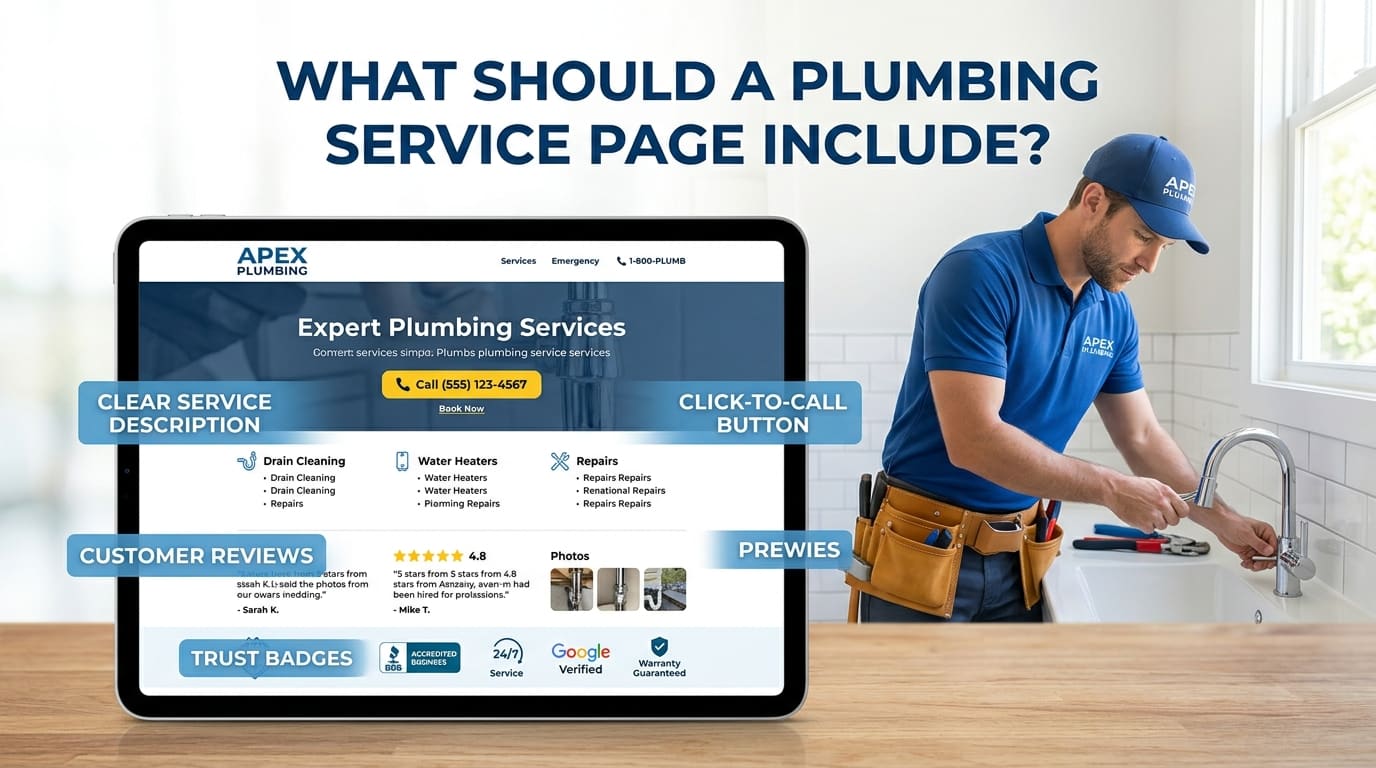
A plumbing service page should explain the work you provide, where it is available, how customers can request it and what happens next. It should also help visitors decide whether your business is suitable for their particular job.
This plumbing service page checklist helps you review those details before publishing a new page or improving an existing one.
Start with one service. A page about tap repairs should explain tap repairs clearly, while a bathroom plumbing page may need more information about project scope, site visits and quotations.
1. A Heading That Identifies the Service
Use a heading that tells visitors what the page covers.
Examples include:
- Tap Repairs and Replacements.
- Toilet Repairs.
- Bathroom Plumbing Installation.
- Leak Detection and Repairs.
A heading such as “Quality Solutions You Can Trust” does not identify the service. It may work as supporting text, but customers still need a clear service name.
Keep the heading consistent with the content. If your page advertises repairs and replacements, explain both rather than discussing only new installations.
2. A Short Explanation of the Work
The opening paragraph should help customers recognise whether they have reached the right page.
For example:
We repair leaking taps and replace faulty fittings in kitchens and bathrooms. Depending on the condition of the tap and the availability of suitable parts, we may recommend a repair or replacement after assessing the problem.
Only use details that reflect your actual service.
Avoid opening with several paragraphs about your company before explaining the work. Visitors can read your business background elsewhere, but this page needs to answer their immediate question.
3. Clear Inclusions and Limitations
Explain what the service can cover and where its scope ends.
For a toilet repair page, this might include assessing leaks, flushing faults and problems with accessible cistern components. If you do not provide specialist drainage work, explain that distinction where relevant.
| Detail | What to explain |
|---|---|
| Included work | Problems and tasks your team handles |
| Assessment | What you need to inspect before recommending work |
| Parts | Whether you supply parts or accept customer-supplied fittings |
| Related work | Whether associated plumbing changes are available |
| Limitations | Work you do not undertake or cannot confirm in advance |
These details help prevent unsuitable enquiries.
You do not need to list every possible fault. Cover the questions that regularly arise when customers contact you.
4. Signs That the Service May Be Relevant
Customers may recognise a problem without knowing the correct service name.
A short section can connect familiar symptoms with the work you provide.
For example, a tap repair page could mention:
- A tap that continues dripping after being turned off.
- Water appearing around the base of the fitting.
- A handle that has become difficult to operate.
- A damaged fitting that may need replacement.
Present these as reasons to request an assessment, rather than a diagnosis.
A symptom can have more than one cause. Your website should not promise a particular repair before the problem has been checked.
5. Availability and Service Coverage
State where the service is available and how appointments are arranged.
Useful information includes:
- Your main operating area.
- Whether you serve homes, commercial premises or both.
- Normal appointment hours.
- Whether availability must be confirmed by telephone.
- Any restrictions relevant to the service.
Keep this section brief if you already have detailed coverage information elsewhere. Link to that information rather than repeating a long list of towns on every service page.
If you offer urgent attendance as a separate service, explain the appropriate contact route. Do not imply that a routine enquiry form receives an immediate response.
6. How Pricing and Quotations Work
Customers need to understand how they will find out the cost, even when you cannot publish a fixed price.
Explain whichever arrangements apply:
| Pricing arrangement | Useful explanation |
|---|---|
| Fixed-price work | What the price includes and any conditions |
| Hourly work | How time is charged and whether a minimum applies |
| Call-out charge | When it applies and what it covers |
| Assessment before quotation | Why inspection is needed before confirming the price |
| Parts charged separately | How parts and additional costs are approved |
Make clear whether displayed prices include VAT, where applicable.
If the final cost depends on access, parts or the condition of existing pipework, explain that in plain language.
Avoid using “from” prices without making their scope understandable. A low starting figure is not useful if customers cannot tell which work it covers.
7. What Happens After an Enquiry
Explain the process from first contact to the next confirmed step.
A simple sequence might be:
- The customer describes the problem or planned work.
- Your team requests any useful photographs or additional details.
- You confirm whether a visit is needed.
- You explain the quotation or assessment arrangements.
- An appointment is agreed, subject to availability.
Adapt the process to your business.
If the form requests an appointment, label it as a request. Submission should not appear to confirm a booking unless your system actually reserves an available slot.
This section can also explain how you communicate, such as by telephone or email.
8. Evidence Relevant to the Service
Help visitors assess your work using information you can verify.
Useful evidence may include:
- Photographs of completed jobs.
- A short explanation of the work shown.
- Genuine customer feedback.
- Relevant qualifications or memberships.
- Accurate insurance information.
A photograph becomes more useful when its caption explains what was completed. For example:
Replacement basin tap fitted during a scheduled bathroom plumbing visit.
Use your own work with appropriate permission. Avoid presenting stock photographs as completed projects.
Only display qualifications, memberships and logos you are entitled to use. If you advertise gas-related services, verify that the business and engineer hold the appropriate registration for the work described.
9. A Contact Option That Suits the Job
Choose a contact route that matches how you assess the service.
A straightforward repair may begin with a telephone conversation. A planned installation may benefit from an enquiry form that allows customers to describe the project.
Keep the form focused. Depending on your process, useful fields could include:
- Name.
- Email address or telephone number.
- Job postcode.
- A short description of the work.
Photographs can be optional where they help your team prepare.
Avoid requesting extensive information that you will not use. Check that the form is easy to complete on a phone and that the confirmation message explains what happens next.
If your website has unclear service descriptions or enquiry routes, our SEO support for plumbing businesses can help you prioritise the pages that need attention.
10. Answers to Service-Specific Questions
Include questions that customers actually ask about that service.
For a fitting replacement page, useful questions might be:
- Can you fit a tap I have already purchased?
- Do you remove the old fitting?
- Will you need access beneath the sink?
- Can you confirm compatibility before the appointment?
For a bathroom installation page, the questions may concern site visits, scheduling and coordination with other trades.
Answer according to your own arrangements. Avoid copying the same general FAQ section onto every page.
A good FAQ resolves uncertainty that could otherwise delay an enquiry.
Plumbing Service Page Checklist
Use this table to review a page before publishing.
| Item | What to check |
|---|---|
| Service heading | Clearly identifies the work |
| Opening explanation | Confirms who the service is for |
| Inclusions | Describes the tasks you undertake |
| Limitations | Explains relevant exclusions |
| Customer problems | Uses understandable examples without diagnosing |
| Coverage | States where the service is available |
| Availability | Reflects actual appointment arrangements |
| Pricing | Explains charges or how quotations are obtained |
| Enquiry process | Describes the next steps |
| Evidence | Uses genuine, relevant and verified material |
| Contact route | Suits the type of job |
| FAQs | Answers questions specific to the service |
| Mobile experience | Keeps information and contact options usable |
| Confirmation message | Explains whether the enquiry or booking is confirmed |
A missing item does not automatically mean you need another section. Add information where it helps the customer make a decision.
What Can Stay on Other Pages?
Your service page does not need to contain everything about your business.
Detailed company history can sit on the About page. Broader coverage information can sit on a service-area page. General contact details can sit on the Contact page.
Include the essentials on the service page and provide relevant links where someone may need more detail.
This keeps the page easier to use and reduces the number of places you must update when business information changes.
Common Problems to Correct
One Description Used for Every Service
If your tap repair, toilet repair and bathroom installation pages contain the same text with different headings, customers receive little help choosing between them.
Explain the actual scope, process and questions for each service.
Important Information Hidden Below Repeated Claims
Statements such as “reliable”, “professional” and “high quality” do not explain availability, charges or the work involved.
Support your introduction with concrete information before adding further promotional copy.
Contact Buttons Without Clear Expectations
A “Book Now” button can be confusing if it opens a general enquiry form.
Use wording such as “Request an Appointment” or “Ask About This Service” when that accurately describes the action.
Details That No Longer Match Your Business
Review telephone numbers, coverage, hours, prices and services when arrangements change.
A well-written page can still create problems if its information is outdated.
Frequently Asked Questions
How long should a plumbing service page be?
Long enough to explain the service and answer the questions customers need resolved. Use the checklist to identify missing information rather than aiming for a fixed word count.
Does every plumbing task need its own page?
No. Closely related tasks can share a page when that makes the information easier to understand. A separate page is more useful when the service has distinct scope, booking arrangements or customer questions.
Should a service page include prices?
Include accurate prices where practical. If inspection is required, explain how customers obtain a quotation and whether any assessment or call-out charge applies.
Can the same customer review appear on several pages?
It can be relevant in more than one place, but choose feedback that helps visitors assess the particular service. Do not alter the wording to imply the customer reviewed work they did not mention.
What Should You Improve First?
Start with information that affects whether customers can enquire confidently: the service scope, coverage, availability, pricing process and contact route.
Then add relevant examples, photographs and answers to recurring questions.
For broader help organising your website and improving search visibility, visit Big Ben SEO.
You may also find useful: Should Emergency Plumbing and Routine Plumbing Have Separate Website Pages? and Why Is Your Plumbing Business Not Showing on Google Maps?.

Written by
Ammar Rafique, Founder
Ammar started Big Ben SEO in 2019 to give small and medium sized UK businesses honest, practical SEO with clear priorities and reports that show what changed.
About Ammar · LinkedIn