


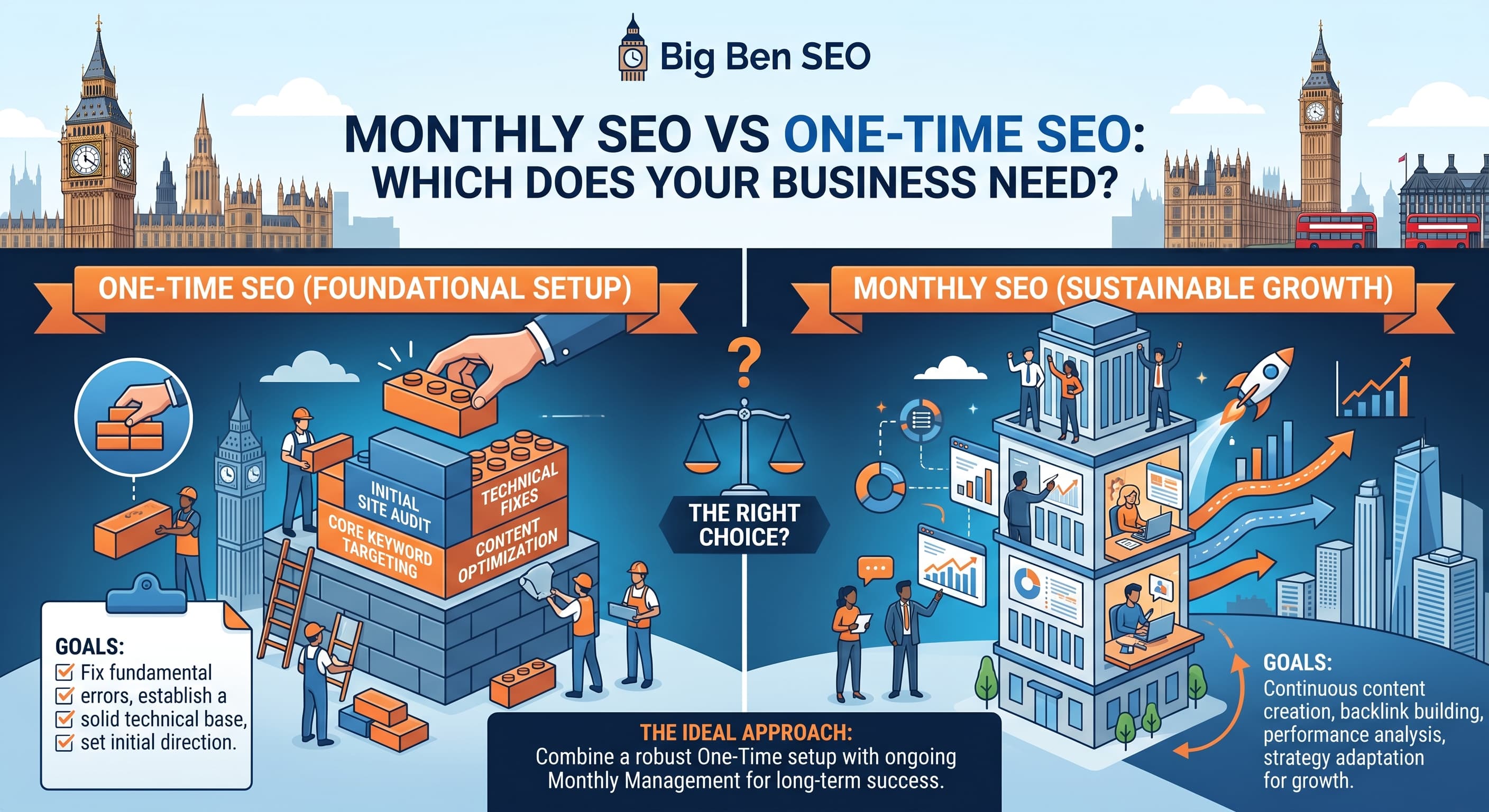
Monthly SEO is normally appropriate when a business wants to build and maintain search visibility in a competitive market. One-time SEO is more suitable when the website has a defined problem, limited scope or needs an initial foundation before ongoing work begins.
The right choice depends on what is preventing the website from performing.
A technically sound website with established rankings may need continuous content, authority and conversion improvements. A smaller website with basic structural problems may benefit more from a focused one-time project before committing to monthly SEO.
This guide compares monthly SEO with one-time SEO and provides a practical framework for deciding which approach fits your website.
What Is One-Time SEO?
One-time SEO, also called one-off SEO, is a project with a defined scope, set of deliverables and completion point.
The work might include:
- An SEO audit
- Keyword research
- Keyword-to-page mapping
- Technical corrections
- On-page optimisation
- Title and meta-description improvements
- Website structure recommendations
- Internal-linking improvements
- Google Search Console configuration
- Analytics and conversion tracking
- Local SEO setup
- Google Business Profile improvements
One-time SEO works best when the objective can be clearly identified and completed.
For example, a business may have launched a new website without setting title tags, internal links, redirects or conversion tracking. A focused project could correct those foundations without requiring an indefinite monthly campaign.
However, completing one SEO project does not permanently optimise a website. Competitors change, search demand develops, websites acquire new problems and Google continues evaluating new and existing content.
What Is Monthly SEO?
Monthly SEO is an ongoing process of reviewing performance, identifying opportunities, implementing improvements and measuring results.
A monthly campaign may include:
- Search performance analysis
- Keyword and competitor research
- Commercial-page improvements
- Technical monitoring
- Content creation and updating
- Internal linking
- Local SEO
- Digital PR or link acquisition
- Conversion improvements
- Reporting
- Strategy adjustments
The work should not consist of repeating the same checklist every month.
Early campaign priorities may focus on technical problems and page mapping. Later months may concentrate on improving pages approaching page one, expanding useful content, building authority or strengthening conversion paths.
Professional monthly SEO services should respond to evidence rather than delivering identical tasks regardless of how the website changes.
Monthly SEO vs One-Time SEO: The Main Differences
| Factor | One-time SEO | Monthly SEO |
|---|---|---|
| Duration | Defined project | Ongoing |
| Scope | Fixed problem or deliverable | Changes with performance and priorities |
| Technical work | Initial audit and selected fixes | Monitoring and continued implementation |
| Keyword research | Initial research and mapping | Updated as rankings and demand change |
| Content | Limited creation or optimisation | Continued improvement and expansion |
| Internal linking | Initial restructuring | Updated when new pages are published |
| Competitor analysis | Snapshot at the time of the project | Reviewed as competitors change |
| Link acquisition | Usually limited | Can continue throughout the campaign |
| Reporting | Completion report | Regular performance reporting |
| Best suited for | Defined website problems | Competitive and growth-focused campaigns |
Neither approach is automatically better. The correct option depends on the website’s condition, market and objectives.
When Is One-Time SEO Appropriate?
One-time SEO can be appropriate in several situations.
A new website needs proper foundations
A new website may need keyword research, page mapping, metadata, technical checks, internal links and tracking before launch.
Completing this work early can prevent structural problems from becoming harder to correct later.
The website has a specific technical problem
A focused project may be sufficient when the problem is clearly defined, such as:
- Important pages are not being indexed
- A migration has caused redirect problems
- Duplicate pages are competing
- Canonical tags are incorrect
- Internal links are broken
- Search engines are crawling unnecessary URLs
- Analytics or conversion tracking is incomplete
A professional SEO audit service can identify the problem and provide a prioritised implementation plan.
A small website needs essential on-page optimisation
A website with five or ten important pages may initially need a limited project covering:
- Search intent
- Page targeting
- Titles and descriptions
- Heading structure
- Content gaps
- Internal links
- Calls to action
This can create a sound foundation, particularly when the market is not highly competitive.
The business has an internal implementation team
Some businesses need external research and strategy but can implement the recommendations internally.
A one-time audit, keyword map or content plan may be enough if the internal team has the time and expertise to complete the work accurately.
The business needs an independent review
A company already paying for SEO may want an independent assessment of:
- Current strategy
- Keyword targeting
- Link quality
- Technical implementation
- Reporting
- Conversion tracking
- Cannibalisation
This does not necessarily require replacing the existing campaign. A focused review can identify whether the current approach is aligned with commercial priorities.
When Is Monthly SEO More Appropriate?
Monthly SEO is usually more appropriate when continued improvement is needed to compete.
The market is competitive
Businesses competing nationally, across several locations or in valuable service sectors rarely reach strong positions through one round of optimisation.
Competitors may continue:
- Improving service pages
- Publishing supporting resources
- Earning links
- Building reviews
- Expanding locations
- Updating products
- Improving user experience
One-time work can improve the website, but it does not respond to competitors that continue investing.
The website has many products, services or locations
Larger websites change regularly.
New products are added, services develop, locations open and old pages become outdated. This creates ongoing work involving:
- Indexation
- canonicalisation
- redirects
- internal links
- category structure
- content updates
- keyword mapping
- performance monitoring
An ecommerce website, for example, may create new filtered URLs, discontinued products and duplicate variants after the initial audit has been completed.
The business wants continued growth
A one-time project can correct existing weaknesses. It does not provide a continuing growth process.
Monthly SEO is more appropriate when the business wants to:
- Enter new locations
- Target additional services
- improve existing rankings
- build non-branded traffic
- increase organic enquiries
- respond to competitors
- develop topical authority
- earn relevant links
Important pages are approaching page one
Pages ranking between positions 4 and 20 can represent valuable opportunities.
These pages may need:
- Search-intent refinement
- Additional supporting information
- Stronger internal links
- Improved titles
- Better trust signals
- Relevant backlinks
- Conversion improvements
Monthly monitoring helps identify these opportunities as they appear.
Performance needs to be measured and adjusted
Search visibility does not improve in a perfectly straight line.
Rankings can change because of seasonality, competitor activity, website updates, search-result features or changes in demand. Ongoing SEO provides time to interpret these changes and adjust priorities.
What One-Time SEO Cannot Guarantee
One-time SEO should not be presented as a permanent solution or a guaranteed route to page-one rankings.
Even a well-executed project cannot control:
- Competitor investment
- Search demand
- Google updates
- New websites entering the market
- Changes made to the website later
- The quality of future content
- Backlinks gained or lost
- Customer behaviour
A one-time project can improve the website’s foundations and resolve defined problems. It cannot freeze the search results after the work is completed.
What Monthly SEO Should Not Become
Monthly SEO should not be an excuse for vague retainers or repetitive activity.
Warning signs include:
- The same task list every month
- Reports containing no commercial interpretation
- Blogs published without page mapping
- Backlinks reported without relevance or destination pages
- No connection between completed work and search data
- Important pages receiving impressions but being ignored
- Technical warnings copied directly from automated tools
- No explanation of next month’s priorities
The business should understand what was completed, why it was prioritised and how the strategy is changing.
A useful monthly report should connect rankings, landing pages, conversions, completed work and next actions. See our guide explaining what a monthly SEO report should include.
A Decision Framework for Choosing Between Them
Use the following questions to assess which option is more appropriate.
1. Is the problem clearly defined?
Choose one-time SEO when there is a specific issue with a clear completion point.
Choose monthly SEO when the objective is continued visibility and growth.
2. How competitive are the target searches?
One-time SEO may be sufficient for a limited website in a low-competition market.
Competitive local, national, ecommerce and B2B searches usually require ongoing work.
3. How frequently does the website change?
A mostly static website may initially need a one-time project.
A website adding products, locations, services or content regularly needs continued oversight.
4. Can your team implement recommendations?
A one-time audit has limited value if nobody implements the findings.
If the business lacks internal capacity, monthly SEO with implementation may be more appropriate.
5. Does the website already have rankings?
A website with pages close to page one may benefit from continuous improvements and authority development.
A website with serious technical or structural problems may need a focused project first.
6. Is the goal maintenance or growth?
Maintaining a small established website may require periodic reviews rather than full monthly management.
Growing visibility across more services, products or locations requires a longer-term strategy.
7. Does the business need links and authority?
Technical corrections and on-page improvements can be completed as a project.
Relevant authority and editorial links usually require continued research, outreach and relationship development.
Quick Scoring Tool
Give your business one point for every statement that applies:
- We operate in a competitive market.
- We want to target several services, products or locations.
- Competitors are actively investing in SEO.
- Our website changes regularly.
- We need continued content improvements.
- We need relevant links or digital PR.
- Several important pages are close to page one.
- We do not have an internal SEO implementation team.
- Organic search is expected to become a significant acquisition channel.
- We want continued measurement and strategy adjustments.
Interpreting the score
| Score | Likely starting point |
|---|---|
| 0 to 3 | One-time SEO or a focused audit may be sufficient |
| 4 to 6 | Begin with an audit, then reassess the need for monthly work |
| 7 to 10 | Monthly SEO is likely to be more appropriate |
This is a planning tool, not a universal rule. Website condition, competition and commercial value still require individual assessment.
Can You Start With One-Time SEO and Move to Monthly SEO?
Yes. For many businesses, this is the most practical sequence.
The process may look like this:
- Conduct an audit.
- Correct urgent technical problems.
- Map keywords to the correct pages.
- Improve priority commercial pages.
- Configure reliable conversion tracking.
- Review the remaining competitive gap.
- Decide whether continued monthly work is justified.
This approach prevents a monthly campaign from beginning without clear priorities.
It also gives the business a better understanding of what ongoing work needs to accomplish.
Can Monthly SEO Be Paused?
It can, but the effect depends on the market and website.
Rankings do not normally disappear simply because monthly SEO stops. However, progress may slow, competitors may improve and new technical or content problems may go unnoticed.
Before pausing, review:
- Current positions
- Pages close to page one
- Organic enquiries
- Competitor activity
- Planned website changes
- Content requiring updates
- Links gained or lost
- Technical health
- Seasonal demand
A temporary pause is different from assuming the website will remain competitive indefinitely without further attention.
How Much Does Each Option Cost?
One-time SEO is usually priced according to the defined project scope.
The cost may depend on:
- Website size
- Number of templates
- Technical complexity
- Ecommerce functionality
- Number of locations
- Depth of keyword research
- Implementation requirements
- Reporting detail
Monthly SEO pricing depends on the continuing resources required for research, implementation, content, technical work, local optimisation, authority development and reporting.
When comparing options, review what is actually included in the proposed small business SEO packages rather than comparing price alone.
A cheaper option may exclude implementation, content, technical fixes or authority work.
Questions to Ask Before Buying Either Option
Ask the provider:
- What problem is this work intended to solve?
- Which pages will be prioritised?
- Is implementation included?
- What will be completed during the first month?
- Which work requires ongoing activity?
- How will conversions be measured?
- What happens after the one-time project?
- How can monthly priorities change?
- Who owns the research, content and reports?
- Are there minimum contract or cancellation terms?
The answers should make the difference between a defined project and an ongoing campaign clear.
Final Answer
Choose one-time SEO when your website has a defined problem, needs a reliable foundation or has an internal team capable of implementing a focused strategy.
Choose monthly SEO when you compete for valuable searches, need continued implementation, regularly change the website or want organic visibility to become a sustained source of enquiries and sales.
Some businesses need both. A one-time audit or foundation project can establish the priorities, while monthly SEO can implement, measure and refine the strategy over time.
The right decision is not based on which option sounds more comprehensive. It depends on whether the website needs a completed project or a continuing process.