


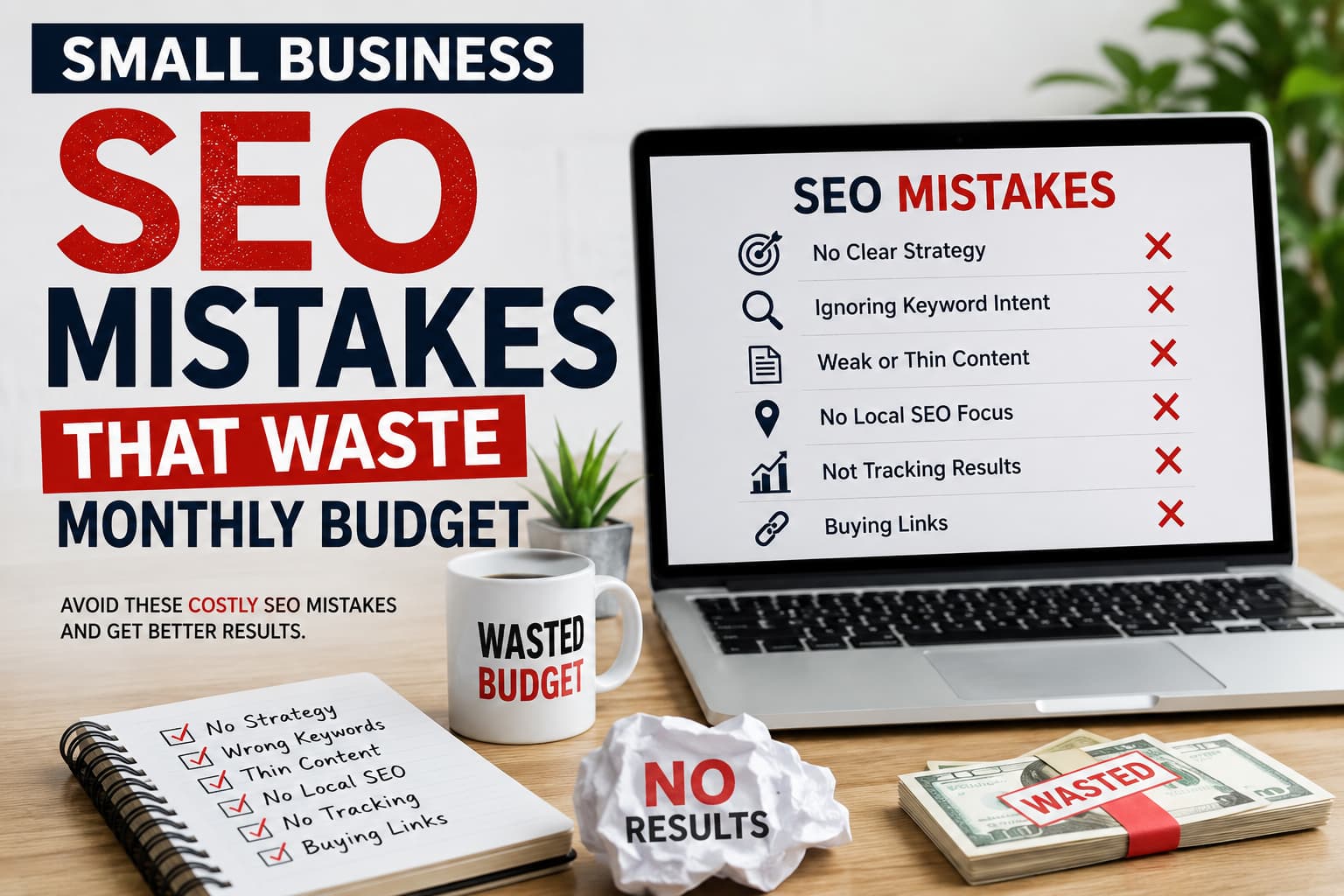
Small businesses often assume that an SEO campaign fails because the budget is too low.
In many cases, the real problem is not the amount being spent. It is how that budget is being used.
A business can pay for SEO every month and still see little progress when the work is disconnected from its main services, focused on low-value activity or repeated without a clear diagnosis.
The most expensive SEO mistake is not always choosing the wrong agency. It is continuing to fund work that does not address the website’s actual limitations.
Publishing More Blogs Before Fixing Commercial Pages
One of the most common small business SEO mistakes is publishing articles while the main service pages remain weak.
A business may add four new blogs every month but still have:
- vague service pages
- weak location relevance
- unclear calls to action
- duplicated content
- poor internal linking
- missing commercial detail
- titles that do not match search intent
Blogs can support a website, but they should not replace the pages responsible for generating enquiries.
A plumber may attract visitors to articles about blocked drains while its emergency plumbing page remains too thin to compete. A consultancy may publish business advice while its core service pages do not explain what it actually delivers.
More content is not always the first solution to an SEO problem.
A useful small business SEO service should prioritise commercially important pages before expanding the blog unnecessarily.
Paying for a Fixed Task List Every Month
Some SEO packages repeat the same tasks regardless of what the website needs.
The monthly checklist may include:
- a fixed number of blog posts
- a fixed number of backlinks
- a fixed number of keywords
- routine title changes
- basic reports
- generic technical checks
A checklist can help organise work, but it should not replace strategy.
A website may need technical corrections in the first month, service-page improvements in the second and local authority work in the third. Repeating identical tasks can waste budget because the website’s priorities change as problems are fixed and new opportunities appear.
The right question is not:
How many tasks are included?
It is:
Why are these tasks the next priority for this website?
Businesses comparing SEO packages for small businesses should look for a clear relationship between the work, the website’s weaknesses and its commercial goals.
Targeting Keywords Without Checking Search Intent
A keyword can look relevant and still be unsuitable.
For example, a small business may target a broad keyword because it has high search volume, even though the search results are dominated by:
- national brands
- directories
- informational guides
- comparison websites
- marketplaces
- government resources
If the business offers a local or specialist service, it may gain more value from a lower-volume keyword with stronger commercial intent.
Search intent determines which type of page should rank.
A service page should usually target service-led intent. A blog should answer a question, explain a problem or help the reader compare options. When those roles are mixed, the website may create several pages competing for the same phrase.
That can lead to the wrong page ranking, unstable visibility or weak conversion performance.
A business should map one primary intent to one main page before creating supporting content.
Choosing Traffic Over Commercial Relevance
Traffic can look impressive in reports, but not every visitor has the same value.
A small business may attract hundreds of visitors from broad informational searches while receiving few enquiries because those users are not looking to buy.
For example:
- a local accountant may rank for general tax definitions
- a cleaning company may rank for home-cleaning tips
- an ecommerce store may rank for product-care questions
- a dental clinic may rank for broad health information
These visits are not automatically useless, but they should support the customer journey.
Useful informational content should guide readers toward:
- a relevant service
- a product category
- a treatment page
- a consultation
- a local landing page
- a commercial comparison
Traffic without a clear relationship to the business model can consume content budget without improving revenue.
A strong SEO campaign connects informational visibility to commercially useful pages.
Ignoring Pages Already Receiving Impressions
Another costly mistake is creating new pages while ignoring existing pages that Google is already testing.
A page may receive hundreds or thousands of impressions but generate few clicks because:
- its title is weak
- its meta description is generic
- its average position is still low
- the page does not fully match the query
- stronger internal links are missing
- the content is not commercially convincing
These pages may offer a better opportunity than starting from zero.
Search Console can reveal:
- high-impression pages
- queries close to page one
- pages with poor click-through rates
- overlapping URLs
- content that Google understands but does not yet rank strongly
A business should often strengthen existing visibility before commissioning more content.
This may involve:
- improving the title and description
- expanding weak sections
- clarifying page intent
- consolidating overlapping pages
- improving internal links
- adding relevant proof
- updating outdated information
SEO budgets are often wasted when new content is treated as the default answer to every problem.
Building Multiple Pages for the Same Keyword
Keyword cannibalisation happens when multiple pages target the same or very similar search intent.
This commonly occurs when a business creates:
- a service page and a blog with nearly identical titles
- several city pages with copied content
- multiple service pages using interchangeable keywords
- an old page and a new page targeting the same phrase
- both singular and plural versions of the same service
The issue is not simply that two pages mention the same keyword.
The problem is that both pages try to perform the same job.
For example, a commercial page targeting a local SEO service should not be supported by a blog that also targets the exact commercial phrase. The blog should answer a related question or problem and then link to the money page.
A supporting article might target:
- how to improve local rankings
- why a business is not showing on Google Maps
- common local SEO mistakes
- how long local SEO takes
The commercial page should retain the main service keyword.
Clear page roles help search engines understand which URL should rank for which intent.
Buying Backlinks Without Strengthening the Target Page
Backlinks can support authority, but they cannot fully compensate for a weak page.
A business may spend money on links while the target page still has:
- thin content
- unclear positioning
- poor internal linking
- weak search intent alignment
- duplicated sections
- missing service information
- a poor mobile experience
The result is often disappointing because authority is being sent to a page that is not ready to compete.
Before investing heavily in backlinks, check whether the page:
- clearly matches the target query
- explains the service properly
- links to related supporting content
- provides a useful next step
- loads correctly
- has a self-referencing canonical
- is included in the sitemap
- is internally accessible
An SEO audit service can help identify whether the main limitation is authority, content, structure or technical performance.
Diagnosis should come before link acquisition.
Treating Local SEO as a Google Business Profile Task Only
A Google Business Profile is important, but it cannot replace a useful website.
Some small businesses focus nearly the entire local SEO budget on:
- profile posts
- categories
- photos
- reviews
- map citations
Those actions may help, but local visibility also depends on the website.
The site should clearly explain:
- which services are offered
- which locations are served
- how service pages differ
- whether the business is genuinely relevant to the area
- how customers can enquire
A profile cannot compensate for a website that hides important local services.
Local SEO works best when the business profile, service pages, location pages, reviews and external citations reinforce the same information.
Reporting Rankings Without Measuring Enquiries
Rankings are useful, but they do not tell the entire story.
A monthly SEO report may show that several keywords improved, yet the business may still receive no meaningful enquiries.
This can happen when:
- the keywords have weak buying intent
- the wrong page is ranking
- the page does not convert visitors
- calls and forms are not tracked
- branded traffic is mixed with non-branded growth
- the business is ranking outside its service area
A useful report should connect SEO activity to commercial outcomes where possible.
That may include:
- organic enquiries
- calls
- form submissions
- bookings
- priority-page visibility
- relevant impressions
- click-through rates
- assisted conversions
- local visibility
- completed work
- next actions
Businesses paying for monthly SEO services should understand not only what changed, but why the next set of work is being recommended.
Choosing the Cheapest Option Without Comparing Scope
A low price is not automatically poor value.
The problem arises when the business compares only the monthly fee and ignores what is actually included.
Two providers charging different amounts may offer completely different levels of work.
One may include:
- technical implementation
- service-page optimisation
- content planning
- internal linking
- local SEO
- reporting
- strategic support
Another may provide only:
- automated reports
- generic blogs
- directory submissions
- basic title changes
The cheapest provider can become expensive if the work produces no meaningful improvement.
The most expensive provider can also waste money if the strategy is too broad for the business.
A better comparison should consider:
- the website’s current condition
- the amount of implementation required
- competition
- number of services
- number of locations
- content needs
- technical complexity
- reporting quality
- communication
- commercial priorities
Reviewing SEO pricing in the UK should involve comparing scope and expected work, not price alone.
Changing Strategy Too Quickly
SEO takes time, but that does not mean a business should wait indefinitely without evidence of progress.
The mistake is often one of two extremes:
- stopping too early
- continuing too long without review
A business may cancel after one or two months before technical and content improvements have had time to be reflected in search.
Another business may continue paying for a year even though:
- no meaningful pages have improved
- reporting lacks explanation
- the same work is repeated
- target pages remain unchanged
- there is no clear plan
A campaign should be reviewed at sensible intervals.
Early progress may include:
- technical fixes completed
- improved indexing
- stronger commercial pages
- increased relevant impressions
- better rankings for priority queries
- clearer internal linking
- improved click-through rates
These are not final outcomes, but they show whether the strategy is moving in the right direction.
SEO requires patience, but it also requires accountability.
How Small Businesses Can Protect Their SEO Budget
A small business does not need to understand every technical detail to make better SEO decisions.
Before approving monthly work, ask:
- Which page is this activity intended to improve?
- What problem does it solve?
- Why is it a priority now?
- How will progress be measured?
- Does a current page already target this keyword?
- Is this a commercial page or a supporting blog?
- What changed since last month?
- What should happen next?
These questions make it harder for an SEO campaign to become a collection of disconnected tasks.
A useful SEO strategy should be able to explain the relationship between:
- the keyword
- the target page
- the work being completed
- the customer journey
- the expected commercial value
The Budget Is Wasted When the Work Has No Clear Purpose
Small business SEO does not fail only because of limited spending.
It often fails because the budget is divided across activity that does not strengthen the pages most likely to generate business.
The most common problems are:
- publishing before fixing
- targeting the wrong intent
- repeating fixed tasks
- ignoring existing impressions
- creating overlapping pages
- buying authority for weak content
- measuring rankings without enquiries
- comparing price without comparing scope
A smaller, focused SEO campaign can outperform a larger one when every task supports a clear commercial priority.
The objective is not to complete the highest number of SEO activities.
It is to identify the right problem, improve the right page and measure whether the work is moving the business closer to meaningful search visibility.