


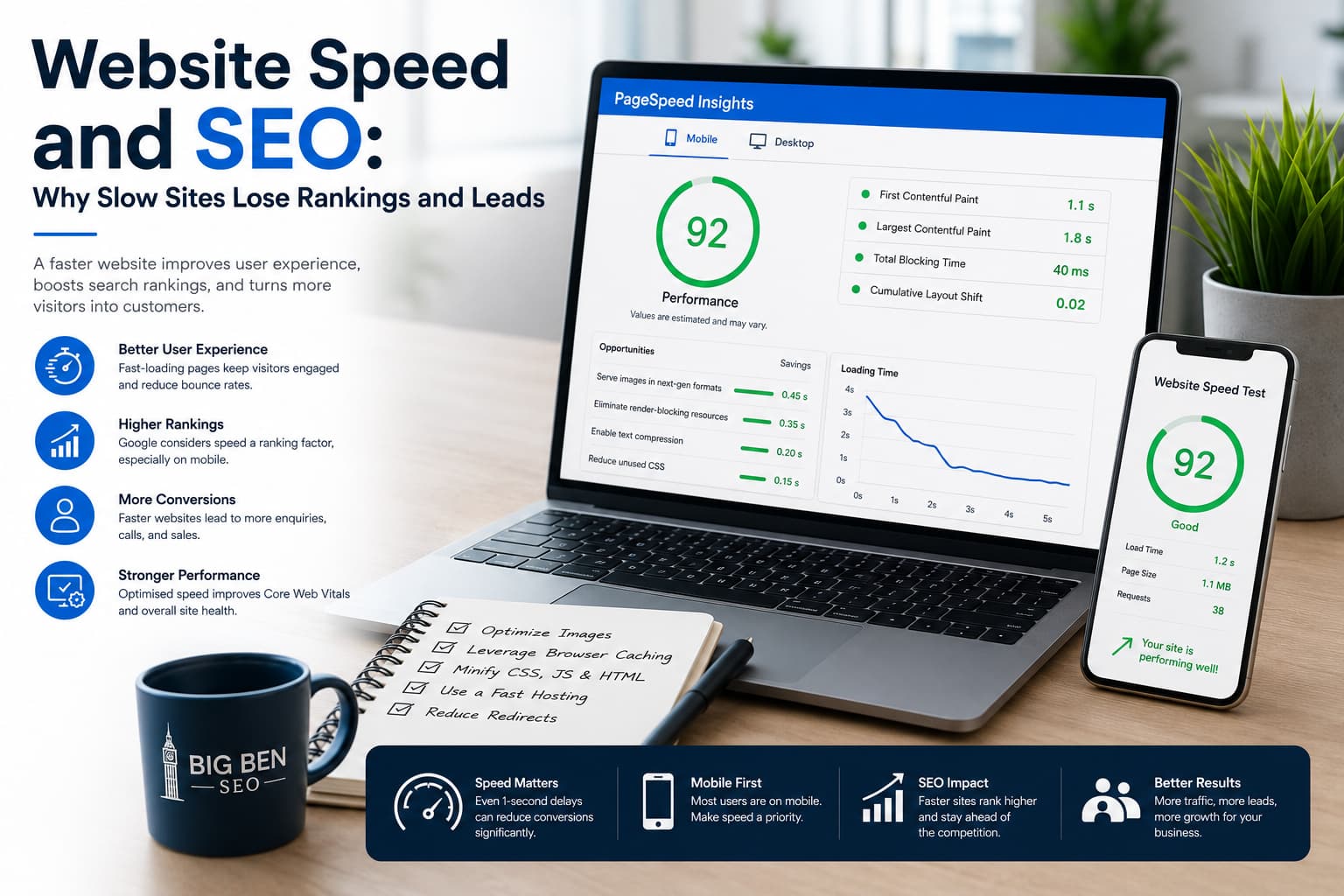
A slow website does more than frustrate visitors.
It can make important pages harder to use, weaken the customer journey and reduce the value of the traffic a business already receives.
For many UK businesses, website speed SEO problems are not caused by one dramatic technical failure. They build up gradually through oversized images, unnecessary plugins, heavy scripts, poor hosting or pages that have been edited repeatedly without performance checks.
The result is a website that may look acceptable on the surface but feels slow when real visitors try to browse it.
Website Speed Affects the Search Experience
Someone arriving from Google usually expects a page to respond quickly.
They may be looking for a service, comparing providers or trying to find contact information.
When the page takes too long to load or elements keep moving while the visitor is trying to read, the experience becomes harder.
This is particularly important on service websites where the next action may be simple:
- read about a service
- check a location
- review pricing
- make an enquiry
- call the business
A slow page adds friction to every one of those steps.
Website speed should therefore be viewed as part of the search journey, not as a separate technical issue.
Slow Websites Can Waste Existing SEO Visibility
A business may already be appearing in search results.
The problem is that users arrive on a page that performs poorly.
For example, a service page may have a clear title and relevant content but take too long to become usable on mobile.
Another site may load the main text quickly but delay the contact form, menu or key call-to-action.
In these situations, the SEO problem is not necessarily a lack of rankings.
The website may already be receiving visibility.
The problem is that the site is making it harder for visitors to continue.
This is why a professional SEO audit service should review performance alongside crawlability, page structure and wider technical SEO issues.
Mobile Speed Matters for Real Customers
Business owners often review their own websites from a desktop computer connected to reliable broadband.
That does not always reflect how customers use the site.
A potential customer may be browsing from a phone, using mobile data or searching while travelling.
Pages with large background videos, oversized images and multiple third-party scripts can feel very different in those conditions.
This is especially relevant for businesses relying on nearby customers.
Someone using Google to find a local service may want to check the service, location and contact information quickly.
That is one reason website performance can overlap with local SEO services.
Getting visibility in local search is only one part of the journey. The website still needs to make the next step easy.
Images Are a Common Source of Website Speed Problems
High-quality images can improve a website.
Poorly handled images can also make pages unnecessarily heavy.
A common problem is uploading a very large image and displaying it in a much smaller space.
For example, a homepage may use a large photograph that was originally created for print or high-resolution design.
The browser still needs to download that large file even if the image appears relatively small on screen.
Other image-related problems may include:
- using the wrong file format
- failing to compress images
- loading images that are not immediately visible
- using several large sliders
- duplicating background images
The solution is not to remove every image.
Images should be prepared for the way they are actually used on the website.
Plugins and Scripts Can Make WordPress Sites Heavy
WordPress websites can accumulate plugins over time.
One plugin may be added for a popup.
Another may control a contact form.
A separate plugin may handle analytics, social feeds, reviews or design effects.
Individually, each feature may appear useful.
Together, they can create a heavy website.
The same problem can occur with third-party scripts.
Chat widgets, tracking platforms, booking systems and marketing tools may all add code to a page.
That does not mean every script should be removed.
The website needs to be reviewed based on business value.
A script that supports real enquiries may be worth keeping.
A plugin that adds a minor visual effect but slows every page may deserve closer attention.
Hosting Can Affect Website Performance
Website optimisation cannot always solve poor server performance.
A website may have compressed images and clean pages but still respond slowly because the hosting environment is limited or poorly configured.
Hosting performance can affect how quickly the server begins sending the page to the visitor.
This is why website speed work should not focus only on front-end design.
The wider technical setup may also need review.
However, changing hosting should not be treated as an automatic solution.
The existing website should first be checked carefully.
Sometimes the main problem is a single heavy page-builder feature or an unoptimised asset rather than the server itself.
Core Web Vitals Are Part of the Performance Conversation
Website speed is broader than one loading-time number.
A page may begin loading quickly but still feel unstable.
Content may move while a visitor is reading.
A button may respond slowly after being clicked.
These types of experience issues are part of the wider performance discussion around Core Web Vitals.
Business owners do not need to become technical specialists to understand the basic concern.
The page should load, remain visually stable and respond properly when someone tries to use it.
Our next guide on Core Web Vitals for business owners looks at these performance signals in more detail.
Page Builders Can Create Performance Problems
Page builders make websites easier to design and edit.
They can also create unnecessary weight when pages are overbuilt.
A simple service page may contain:
- multiple nested sections
- animated headings
- entrance effects
- background overlays
- several font variations
- hidden desktop and mobile elements
The visitor may only see a straightforward page.
Behind the design, the browser may be processing much more.
This does not mean businesses must abandon visual builders.
The goal is to use them carefully.
A clear page with useful content and a simple enquiry path often needs less complexity than expected.
Speed Problems Can Affect Different Industries Differently
The commercial impact of a slow website depends partly on how customers use the site.
A customer searching for a local plumber may want a phone number immediately.
Someone researching an ecommerce product may move between category and product pages several times.
A potential patient comparing healthcare providers may review service information before deciding whether to enquire.
An online store working on ecommerce SEO may therefore need to review product templates, category pages and image loading.
A service business using SEO for plumbers may need to prioritise fast mobile access to emergency service information and contact options.
The technical problem may be similar, but the pages that matter commercially are different.
Website Speed and SEO Should Be Reviewed Page by Page
Looking only at the homepage can hide important problems.
A homepage may perform well while a high-value service page is slow.
An ecommerce site may have a fast category page but heavy product templates.
A local business may have a simple homepage but poorly optimised location pages.
Performance checks should therefore consider the pages that matter commercially.
This may include:
- core service pages
- high-traffic landing pages
- location pages
- important blog articles
- product or category pages
The priority should be based on how the website is actually used.
A proper technical SEO audit should identify where the performance problem appears rather than assuming the entire website has the same issue.
A Perfect Speed Score Is Not the Only Goal
Businesses can become overly focused on achieving a specific performance score.
A website may score slightly below perfect and still provide a strong user experience.
Another site may achieve a high test score while its content, navigation or enquiry process remains poor.
Performance metrics are useful.
They help identify issues and measure changes.
But the wider goal is a website that is fast enough, stable and easy to use.
SEO decisions should not damage useful website features simply to improve one number.
The right question is whether a performance issue is creating a meaningful problem for visitors or search visibility.
Slow Websites Can Also Lose Leads
The commercial impact of speed is easy to overlook.
Imagine someone comparing three service businesses.
The first website loads quickly and clearly explains the service.
The second takes several seconds before the main page becomes usable.
The third loads, but the enquiry button keeps moving as other elements appear.
The customer may not consciously analyse website performance.
They simply continue with the site that is easier to use.
This matters whether a business is investing in SEO, PPC or another acquisition channel.
For companies already paying for ongoing optimisation through monthly SEO services, website performance should be considered where it is affecting important landing pages or enquiry paths.
Traffic has limited value if the website makes the next step unnecessarily difficult.
How Should Businesses Improve Website Speed?
The correct approach depends on the website.
A WordPress service site may need plugin and image optimisation.
An ecommerce store may need template, script and product image reviews.
A larger website may have technical issues across several page types.
The first step should be identifying the actual cause of the problem.
Possible improvements may include:
- compressing and resizing images
- removing unnecessary scripts
- reviewing unused plugins
- improving caching
- reducing heavy design elements
- reviewing hosting performance
- fixing layout stability issues
Changes should be tested carefully.
Randomly installing several speed plugins at once can create new problems and make it difficult to understand which change helped.
Website Speed Should Support the Wider SEO Strategy
A fast website will not automatically rank for competitive searches.
Likewise, strong content cannot fully compensate for a website that is difficult to use.
Performance works best as part of the wider SEO process.
The website needs relevant pages, clear site structure, useful content and appropriate technical foundations.
If a site is slow, the solution should be based on the actual problem rather than generic optimisation advice.
A detailed SEO audit for UK businesses can help identify whether website speed is a major limitation or one issue among several affecting organic visibility.
The goal is not speed for the sake of a score.
The goal is a website that gives search visitors a clear, stable and usable path towards the information or service they need.