


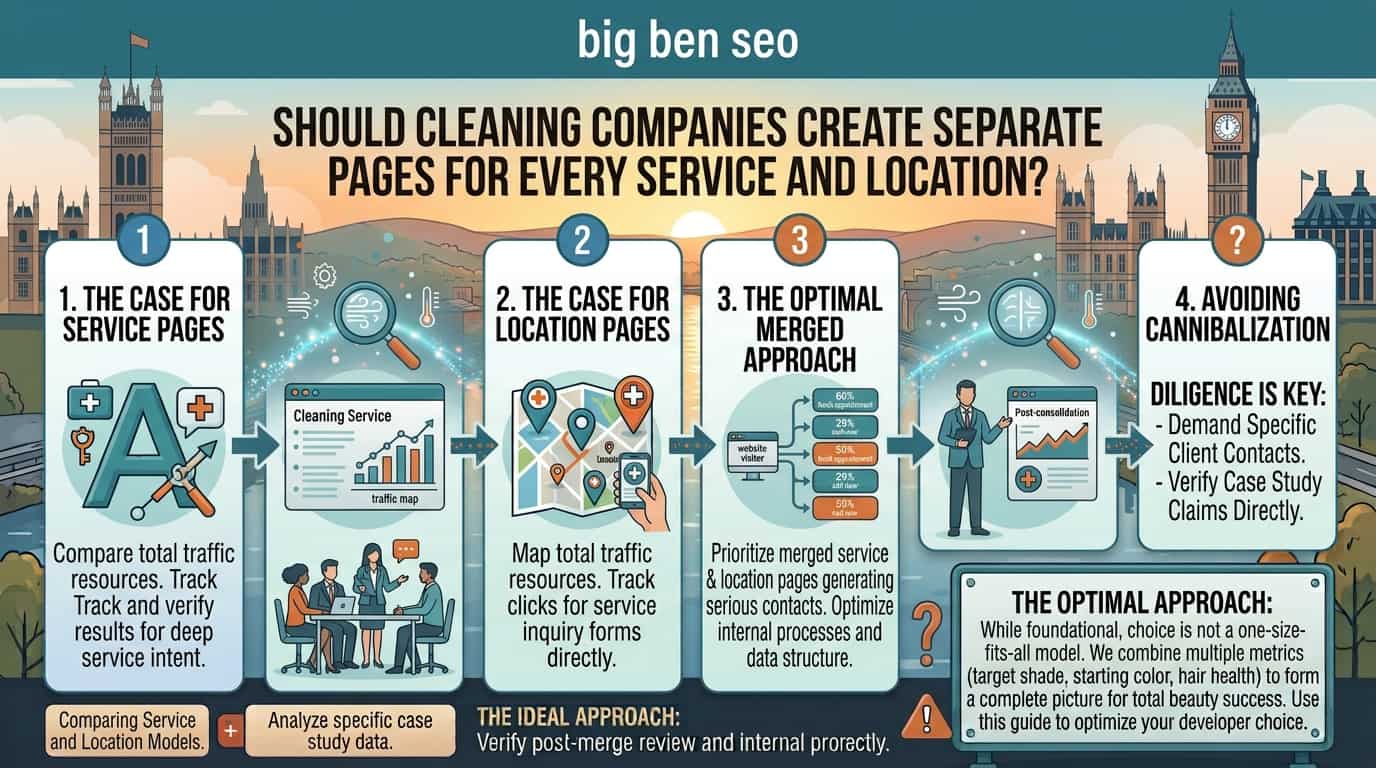
Cleaning companies often provide several services across multiple towns or cities. This creates an important website structure question: should every service and location have its own page?
In most cases, important services should have separate pages. Important locations may also need their own pages. However, creating a page for every possible combination of service and location can produce repetitive content that offers little value to visitors.
The right structure depends on search demand, differences between services, the areas genuinely covered and whether each page can provide useful information of its own.
This guide explains how to structure cleaning company service pages without creating hundreds of weak or duplicated pages.
Why one general services page is rarely enough
A single services page may list everything a cleaning company provides, but it is unlikely to answer every potential customer’s questions.
Someone looking for end of tenancy cleaning will have different requirements from someone searching for regular office cleaning. Their priorities, property types, booking process and expectations may be completely different.
Separate service pages allow a cleaning company to explain:
- What the service includes
- Who the service is suitable for
- The types of properties covered
- How pricing or quotations work
- Which areas are served
- What equipment and cleaning products are used
- How customers can request a quotation
- Why the company is qualified to provide that service
These pages also give search engines a clearer understanding of the services offered by the business.
A page dedicated to office cleaning, for example, has a better opportunity to address office cleaning questions than a general page containing only one paragraph about it.
Which cleaning services should have their own pages?
A service generally deserves a separate page when it represents a distinct customer requirement and has enough information to support a useful page.
Depending on the company, separate pages might be appropriate for:
- Domestic cleaning
- Commercial cleaning
- Office cleaning
- End of tenancy cleaning
- Deep cleaning
- Carpet cleaning
- After-builders cleaning
- School cleaning
- Medical facility cleaning
- Retail cleaning
- Airbnb cleaning
- Communal area cleaning
This does not mean every minor task requires a page.
For example, dusting, vacuuming and mopping would normally be included within a broader cleaning service. Creating individual pages for these tasks would be unnecessary because customers rarely purchase them independently.
A useful test is to ask:
Could a customer book this as a distinct service, and would they need different information before making an enquiry?
If the answer is yes, a separate page may be justified.
Should every location have a separate page?
Location pages can be valuable when a cleaning company genuinely operates across several areas. They help prospective customers confirm that the company covers their town, borough or district.
However, a business should not automatically create a separate page for every nearby postcode.
A location page is most useful when:
- The company regularly serves the area
- There is evidence of demand for the service in that location
- The business can provide accurate local information
- The page can include relevant projects, reviews or service details
- The area is commercially important to the company
For example, a cleaning company based in Watford that regularly serves St Albans, Hemel Hempstead and Bushey may benefit from dedicated pages for those locations.
A page for a distant town in which the company has never completed work would be much harder to justify.
The difference between service pages and location pages
Service pages and location pages answer different questions.
A service page answers:
Can this company provide the type of cleaning I need?
A location page answers:
Does this company provide cleaning services in my area?
This distinction should shape the content.
A service page should focus on the cleaning process, inclusions, property types, standards and relevant customer concerns.
A location page should focus on coverage, local availability, services offered within that area and evidence that the business genuinely operates there.
Using the same text on both types of pages and simply changing the service or town name produces a poor experience for visitors.
Should you create service and location combination pages?
A cleaning company offering five services across ten locations could theoretically create 50 pages.
Examples might include:
- Office cleaning in Watford
- Office cleaning in St Albans
- Office cleaning in Hemel Hempstead
- Carpet cleaning in Watford
- Carpet cleaning in St Albans
- Carpet cleaning in Hemel Hempstead
This structure can work for larger companies with genuine demand, local experience and enough unique information for every page. For most smaller cleaning companies, however, it creates more pages than they can maintain properly.
A safer starting structure is:
- One strong page for each main service
- One useful page for each priority location
- Combination pages only for proven, commercially important opportunities
Before creating a service and location combination page, confirm that:
- Customers search for that particular service in that area.
- The company genuinely provides the service there.
- The page can contain information that is not copied from other pages.
- The opportunity is valuable enough to justify maintaining the page.
- The page serves a clear purpose beyond capturing a keyword.
If these conditions cannot be met, the service can be mentioned naturally on the main location page instead.
What should a cleaning service page include?
A useful service page should help the visitor decide whether the service meets their needs.
Consider including:
A clear explanation of the service
Explain what the service is, who it is intended for and the situations in which customers normally need it.
What is included
List the main tasks, rooms, surfaces or areas covered. If certain tasks cost extra, make that clear.
Types of properties served
Specify whether the service is available for homes, offices, schools, retail premises, medical facilities, warehouses or managed properties.
The cleaning process
Explain what happens after an enquiry, including the assessment, quotation, scheduling, cleaning and quality-checking stages.
Credentials and standards
Include relevant insurance, staff vetting, training, health and safety procedures or industry accreditations.
Evidence of previous work
Use original photographs, customer testimonials, project summaries or short case studies where possible.
Service area
State where the service is available and link to relevant location pages.
Frequently asked questions
Answer practical questions about access, equipment, products, scheduling, pricing and preparation.
A clear next step
Provide a visible quotation form, telephone number or consultation button.
What should a cleaning company location page include?
A strong location page should demonstrate genuine coverage rather than repeatedly inserting the town name.
Useful elements include:
- An introduction to the services available locally
- The types of customers served in that area
- Specific neighbourhoods or postcodes covered
- Relevant local projects or examples
- Testimonials from nearby customers
- Expected availability or response times
- Links to individual cleaning services
- A quotation or contact option
If possible, include first-hand information. This might be a completed office-cleaning project, a recurring commercial contract or an explanation of how teams are scheduled within the area.
This evidence makes the page more credible for both visitors and search engines.
How to avoid duplicated location pages
Location pages become problematic when the business creates the same page repeatedly and changes only the place name.
For example:
We provide professional cleaning services in Watford.
becomes:
We provide professional cleaning services in St Albans.
The remainder of each page stays identical.
This approach does not give customers meaningful local information. It can also leave search engines uncertain about which page is the most useful result.
To avoid this:
- Write each location page around genuine local circumstances
- Include different project examples and testimonials
- Discuss the services most relevant to that area
- Use original photographs where available
- Avoid automatically generating hundreds of pages
- Combine locations when there is not enough information for individual pages
- Remove pages for areas the company no longer serves
Quality is more important than the total number of pages.
A practical website structure for a cleaning company
A small or medium-sized cleaning business might use the following structure:
Main navigation
- Home
- Services
- Areas Covered
- About
- Case Studies
- Contact
Service section
- Domestic Cleaning
- Office Cleaning
- End of Tenancy Cleaning
- Deep Cleaning
- Carpet Cleaning
Location section
- Cleaning Services in Watford
- Cleaning Services in St Albans
- Cleaning Services in Hemel Hempstead
- Cleaning Services in Bushey
Each location page can link to the relevant service pages. Each service page can link to the principal areas where that service is available.
This creates a logical connection between services and locations without requiring a separate page for every combination.
How should the pages link to one another?
Internal links help customers navigate the website and show search engines how the pages relate to each other.
A location page might say:
Businesses in Watford can choose from our office cleaning, carpet cleaning and after-builders cleaning services.
The service names should link to their corresponding service pages.
An office-cleaning page might say:
Our office cleaning service is available to businesses in Watford, St Albans and surrounding areas.
Those locations can link to their relevant area pages.
The website should also link naturally to the main Big Ben SEO homepage and, where relevant, explain how professional SEO for cleaning companies can help organise and improve this structure.
Avoid placing the same keyword-rich link repeatedly throughout every page. Internal links should be helpful and fit naturally into the surrounding sentence.
When should pages be combined?
Not every service or location needs its own URL.
Combine pages when:
- Two services are nearly identical
- Searchers are likely to consider the services together
- There is not enough useful information for separate pages
- The company rarely provides one of the services
- Several small locations form one practical service area
- Separate pages would contain substantially similar content
For example, a company might combine oven cleaning and appliance cleaning within its deep-cleaning page rather than creating several short pages.
Similarly, several neighbouring villages may be covered by one broader county or regional page.
When should a page be split?
A page may need to be divided when:
- It serves several clearly different customer needs
- The page has become difficult to navigate
- Each service has a different process or audience
- Customers frequently ask service-specific questions
- Each topic has enough evidence and information to support a complete page
- Search performance indicates interest in a distinct service
Suppose a general commercial-cleaning page discusses offices, schools, medical facilities and industrial premises. If the company has substantial experience in each sector, separate pages may provide clearer and more relevant information.
How do you know whether the structure is working?
Website structure should be reviewed using business and search-performance data.
Monitor:
- Which pages receive relevant impressions and clicks
- Which pages generate enquiries
- Whether multiple pages appear for the same search
- Whether important services receive little visibility
- Whether users move between service and location pages
- Which pages have high exit rates or low engagement
- Whether enquiries come from the intended service areas
Google Search Console can reveal whether several pages are competing for similar searches. Analytics and call tracking can show which pages produce genuine leads.
Do not judge a page solely by traffic. A page receiving ten highly relevant visits and two enquiries may be more valuable than one receiving hundreds of visitors who never contact the company.
Final recommendation
Cleaning companies should create separate pages for their most important services and priority locations, but they should not create every possible service and location combination automatically.
Start with a simple structure:
- Create one substantial page for each main service.
- Create one useful page for each priority service area.
- Connect the pages through relevant internal links.
- Add combination pages only when there is genuine demand and sufficient unique information.
- Review performance before expanding the structure.
The purpose of each page should be to help a potential customer make a decision. If a page exists only to repeat a keyword with a different town name, it probably should not exist.
A carefully planned structure makes the website easier to understand, easier to navigate and better aligned with the way prospective customers search for cleaning services.
Frequently Asked Questions
Does every cleaning service need its own page?
No. A service should normally have its own page when customers can book it separately and need distinct information about it. Minor tasks can remain part of a broader service page.
How many location pages should a cleaning company create?
There is no ideal number. Create pages for areas the company genuinely serves and prioritises. Each page should contain helpful local information rather than duplicated text.
Are service and location combination pages harmful?
Not automatically. They can be useful when there is genuine search demand and each page contains unique, relevant information. Large numbers of repetitive combination pages are unlikely to help customers.
Can one page rank for several nearby locations?
Yes. A strong regional or service-area page can cover several neighbouring locations, particularly when there is not enough information to justify separate pages.
Should location pages contain different content?
Yes. Each location page should include information specific to that area, such as available services, local examples, testimonials, coverage details and relevant customer requirements.
What is the best starting structure for a cleaning company website?
Begin with separate pages for the company’s core services and most valuable locations. Add more pages only when customer demand, business data or search performance justifies the expansion.