


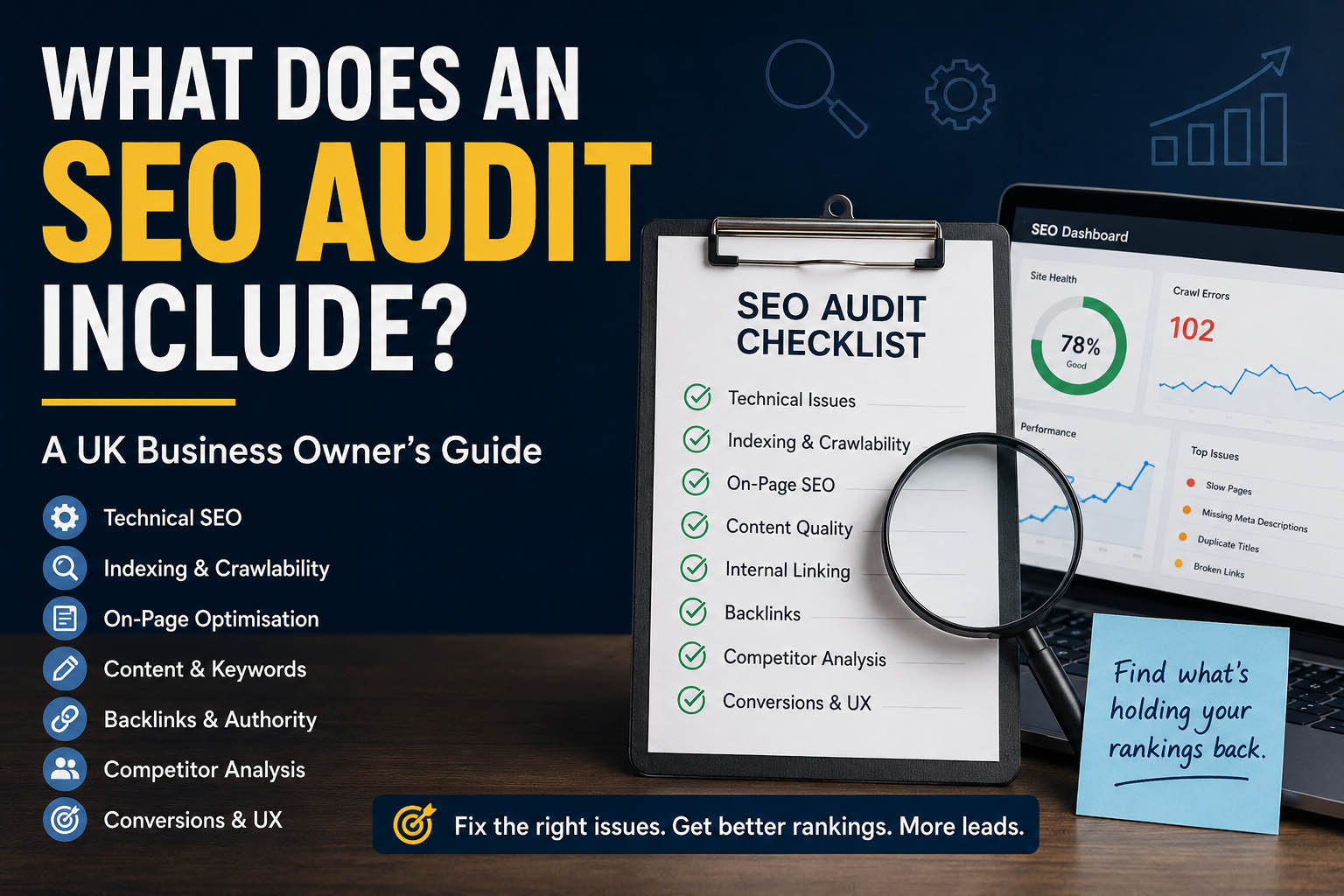
A proper SEO audit should not just give you a score.
It should show what is stopping your website from ranking, which pages need fixing first, and whether your SEO problems are technical, content-related, local, structural, or strategy-related.
That is the part many business owners miss. They think an SEO audit is just a checklist of errors. Missing meta descriptions. Slow pages. Broken links. Image alt text. Maybe a few keyword suggestions.
Those things can matter, but they are not the whole picture.
A useful SEO audit should explain what is actually holding the website back from better rankings, better traffic, and better enquiries.
If you want this reviewed professionally, our SEO audit services for UK businesses can help identify the issues holding your rankings back.
What Is an SEO Audit?
An SEO audit is a detailed review of your website’s ability to rank in search engines.
It checks how well your website can be crawled, indexed, understood, trusted, and converted into business results.
A proper SEO audit usually reviews:
- Technical SEO
- Indexing and crawlability
- Website structure
- Keyword targeting
- Search intent
- On-page SEO
- Content quality
- Internal linking
- Competitor gaps
- Backlink profile
- Local SEO signals
- User experience
- Conversion issues
The goal is not to find every tiny issue.
The goal is to find the issues that actually affect visibility, rankings, leads, and revenue.
That is why a real SEO audit should give you priorities, not just problems.
Why An SEO Audit Matters Before Spending More On SEO
Many businesses spend money on SEO without knowing what is broken.
They publish more blogs. They buy backlinks. They rewrite service pages. They pay for monthly SEO. But rankings stay flat because the main issue was never properly diagnosed.
For example:
- More content will not fix pages that are not indexed.
- Backlinks will not fix poor service page targeting.
- Better meta titles will not fix duplicate keyword intent.
- A faster homepage will not fix weak location pages.
- More blogs will not help if internal links are messy.
- A new design will not help if the website loses rankings during migration.
This is why an SEO audit should come before heavy execution.
It protects your budget.
It tells you what to fix first.
It stops you from guessing.
If you are already comparing SEO retainers, read our SEO pricing breakdown for UK businesses before committing to another monthly campaign.
1. Technical SEO Review
Technical SEO is usually the first major part of an audit.
This checks whether search engines can crawl, render, and understand your website properly.
A technical SEO review may include:
- Crawl errors
- Broken internal links
- Redirect chains
- 404 errors
- HTTPS issues
- XML sitemap problems
- Robots.txt issues
- Canonical tag errors
- Duplicate URLs
- Page speed problems
- Core Web Vitals
- Mobile usability
- Structured data
- JavaScript rendering issues
- WordPress plugin conflicts
- Theme or page builder bloat
This is especially important for WordPress websites.
A website can look good visually but still have technical problems underneath. Elementor layouts, too many plugins, caching conflicts, bloated themes, poor hosting, and bad redirects can all affect SEO performance.
The point of technical SEO is not to chase perfect scores.
The point is to remove anything that stops Google from accessing and understanding your important pages.
2. Crawlability Check
Crawlability means checking whether search engines can access your pages.
If Google cannot crawl a page, that page has almost no chance of ranking.
A crawlability check looks at:
- Whether important pages are reachable
- Whether internal links point to key pages
- Whether robots.txt blocks anything important
- Whether pages are buried too deep
- Whether broken links waste crawl paths
- Whether redirects are clean
- Whether navigation helps Google find the right pages
For small websites, crawlability is usually simple.
For larger websites, ecommerce stores, service-area websites, or sites with many blog posts, crawlability can become messy.
A good audit should show whether Google can easily reach the pages that matter most.
3. Indexing Review
Indexing is different from crawling.
Google may crawl a page but still choose not to index it.
An indexing review checks which pages Google has actually stored and may show in search results.
This part of the audit should review:
- Indexed pages
- Excluded pages
- Discovered but not indexed pages
- Crawled but not indexed pages
- Duplicate pages
- Canonical issues
- Thin pages
- Tag and category pages
- Old pages that should not be indexed
- Important pages missing from the index
This is where many business websites lose opportunities.
Sometimes Google indexes low-value pages while ignoring commercial pages. Sometimes old posts, category pages, author archives, and duplicate URLs take attention away from money pages.
An audit should help you understand whether Google is indexing the right pages, not just more pages.
4. Keyword Targeting Review
An SEO audit should check whether your pages are targeting the right keywords.
This is not just about adding keywords into content.
It is about matching each page to one clear search intent.
A keyword targeting review checks:
- Primary keyword for each important page
- Secondary keywords
- Page title and H1 alignment
- Search intent match
- Keyword overlap
- Missing commercial keywords
- Ranking keywords from Google Search Console
- Pages ranking for the wrong terms
- Pages with impressions but low clicks
For example, a service page should target commercial intent. A blog should usually support a service page, answer a question, or build topical authority.
If a blog and service page target the same intent, they may compete with each other.
That is why one page should own one primary keyword.
5. Search Intent Review
Search intent means understanding what the searcher actually wants.
This is one of the most important parts of an SEO audit.
A page can mention the right keyword and still fail because it does not match intent.
For example:
Someone searching “what does an SEO audit include” probably wants an explanation before choosing whether they need help.
Someone searching “SEO audit services” is closer to hiring.
Those two keywords are related, but they should not be treated the same.
This blog explains the audit process.
Your service page sells the audit.
That is how you avoid cannibalization.
A search intent review checks whether each page is written for the correct stage of the buyer journey.
6. Keyword Cannibalization Check
Keyword cannibalization happens when multiple pages compete for the same search intent.
This is common when websites publish too much content without a clear cluster plan.
Examples of possible cannibalization:
- SEO audit services
- SEO audit checklist
- What does an SEO audit include
- Technical SEO audit services
- SEO audit company
These topics can all exist on the same website, but only if each page has a separate job.
The service page should target “SEO audit services.”
This blog targets “what does an SEO audit include.”
Another blog can target “SEO audit checklist.”
Another can target “technical SEO audit services.”
A good audit should identify pages that are overlapping and recommend how to separate them through content, headings, internal links, and page purpose.
7. On-Page SEO Review
On-page SEO looks at the actual page content and structure.
This includes:
- SEO title
- Meta description
- URL slug
- H1 heading
- H2 and H3 structure
- Keyword placement
- Content depth
- Image alt text
- Internal links
- External links
- Schema markup
- CTA placement
- Readability
- Search intent match
On-page SEO is not about stuffing keywords.
It is about making the page easy for both users and search engines to understand.
A good page should quickly answer:
- What is this page about?
- Who is it for?
- What problem does it solve?
- What should the visitor do next?
- Why should the visitor trust this business?
That is where professional SEO services for UK businesses should go beyond basic keyword edits.
8. Content Quality Review
Content quality is a major part of an audit.
A content review checks whether your pages actually deserve to rank.
This does not mean every page needs to be long. It means every page needs to satisfy the search intent better than competing pages.
A content review may check:
- Thin content
- Outdated content
- Duplicate content
- Generic AI-style writing
- Weak introductions
- Poor heading structure
- Missing examples
- Missing commercial detail
- Unclear service descriptions
- Weak FAQs
- Lack of authority
- No clear next step
For service businesses, content should not sound like every other website.
It should show business understanding, buyer psychology, examples, local relevance, and a clear offer.
That is the difference between content that exists and content that sells.
9. Service Page Review
A proper SEO audit should review your main service pages closely.
These pages usually matter more than blog posts because they generate enquiries.
A service page review checks:
- Page focus
- Keyword targeting
- Offer clarity
- Above-the-fold messaging
- Trust signals
- Pricing guidance
- CTA placement
- Internal links
- FAQs
- Proof
- Local relevance
- Conversion path
A common SEO mistake is publishing blogs while the service pages remain weak.
Blogs can support authority, but service pages usually convert traffic into leads.
If those pages are vague, thin, or generic, rankings may not turn into enquiries.
10. Internal Linking Review
Internal linking is one of the most underrated parts of SEO.
An audit should check how pages connect to each other.
Internal linking helps Google understand:
- Which pages are important
- Which pages support each other
- Which page should rank for which topic
- How authority flows through the site
A strong internal linking review checks:
- Pages with no internal links
- Important pages buried too deep
- Repeated anchor text
- Random links
- Blogs not supporting pillars
- Old posts not linking to new pages
- Service pages missing support
- Location pages disconnected from services
For example, this blog should link to your SEO Audit Services page because this blog answers a question and the service page offers the solution.
That is how supporting content should work.
11. Website Structure Review
Website structure affects both rankings and user experience.
A good audit should check whether the site is organised clearly.
For an SEO agency website, the structure might include:
- Homepage
- Service pages
- Industry pages
- Location pages
- Blog clusters
- Pricing page
- Contact page
Each part should have a clear job.
Service pages target core services.
Industry pages target niche buyers.
Location pages target local commercial searches.
Blogs support pillars.
If everything is mixed together, Google and users both get confused.
Clean structure helps crawl efficiency, topical authority, and conversion.
12. Local SEO Review
If your business serves local clients, local SEO should be part of the audit.
A local SEO review may check:
- Google Business Profile
- NAP consistency
- Local landing pages
- Location keywords
- Google Maps visibility
- Reviews
- Local backlinks
- Service area relevance
- Local schema
- City page quality
For local service businesses, this can be the difference between traffic and actual phone calls.
A website may rank nationally for informational terms but still fail to generate local leads.
A proper audit should check both organic search and local search visibility.
13. Competitor Review
An SEO audit should not only look at your website.
It should also look at the websites already ranking.
A competitor review checks:
- Which pages rank
- What type of content ranks
- How competitors structure pages
- How detailed their pages are
- Their internal linking
- Their topical coverage
- Their backlink profile
- Their local pages
- Their service pages
- Their trust signals
The goal is not to copy competitors.
The goal is to understand why they are winning.
Sometimes they have stronger content. Sometimes they have better links. Sometimes their page matches intent better. Sometimes your page is simply targeting the wrong keyword.
A useful audit should make that clear.
14. Backlink and Authority Review
Backlinks still matter, but quality matters more than quantity.
A backlink review checks:
- Referring domains
- Link quality
- Toxic links
- Spam links
- Anchor text profile
- Competitor backlinks
- Local links
- Industry links
- Lost links
- Over-optimised anchors
Not every website needs aggressive link building immediately.
Sometimes technical fixes and better pages should come first.
Sometimes authority is the missing piece.
The audit should tell you which situation applies.
15. Conversion Review
SEO traffic is only useful if it can turn into business.
That is why conversion should be part of a serious SEO audit.
A conversion review may check:
- Contact forms
- Phone visibility
- CTA buttons
- Trust signals
- Testimonials
- Page layout
- Mobile usability
- Offer clarity
- Pricing concerns
- Lead magnet options
- Navigation
- Friction points
Many websites do not have an SEO problem only.
They have a conversion problem.
They may get visits, but the page does not make people trust the business enough to enquire.
SEO should not stop at rankings. It should support business growth.
16. Analytics and Search Console Review
A proper audit should use real data where possible.
Google Search Console and Google Analytics can show what is actually happening.
This may include:
- Queries generating impressions
- Pages getting clicks
- Pages losing traffic
- Click-through rates
- Indexing issues
- Device performance
- Conversion paths
- Traffic sources
- Landing page performance
- Pages with opportunity
This is where the audit becomes more practical.
Instead of guessing, you can see which pages Google already understands, which pages need improvement, and where quick wins may exist.
What Should You Receive After an SEO Audit?
A good SEO audit should give you more than a long PDF.
It should give you:
- Clear findings
- Technical issues
- Indexing issues
- Keyword problems
- Content gaps
- Internal linking recommendations
- Competitor insights
- Service page recommendations
- Conversion observations
- Priority action plan
The priority action plan is the most important part.
You should know:
- What to fix first
- What can wait
- Which pages matter most
- Which issues are hurting rankings
- Which opportunities can bring leads
- Whether ongoing SEO is worth it
Without priorities, an audit is just information.
With priorities, it becomes a roadmap.
SEO Audit Checklist For Business Owners
Here is a simple checklist to understand what should be included:
- Technical SEO health
- Crawlability
- Indexation
- Keyword targeting
- Search intent
- Cannibalization
- On-page SEO
- Service page quality
- Content quality
- Internal links
- Site structure
- Local SEO
- Competitor analysis
- Backlink profile
- Analytics review
- Conversion review
- Priority action plan
If an audit does not cover most of these areas, it may be too shallow.
What Cheap SEO Audits Usually Miss
Cheap audits often focus on basic tool outputs.
They may flag:
- Missing alt text
- Missing meta descriptions
- Broken links
- Low word count
- Slow pages
- Basic keyword usage
Those things are not useless, but they are not enough.
Cheap audits often miss:
- Wrong search intent
- Weak service pages
- Poor internal linking
- Cannibalization
- Wrong pages indexed
- Low-value indexed pages
- Thin location pages
- Generic content
- Poor conversion flow
- Competitor strategy gaps
A cheap audit gives you a list.
A real audit gives you direction.
How Often Should You Get An SEO Audit?
Most business websites should get an SEO audit at least once a year.
You should also audit when:
- Rankings drop
- Traffic falls
- Leads slow down
- You redesign the website
- You migrate the site
- You change URL structure
- You add many new pages
- You hire a new SEO agency
- You launch location pages
- You launch industry pages
- Google stops indexing pages
For growing websites, audits are not a one-time thing.
They are part of keeping the site clean as it expands.
Final Thoughts
So, what does an SEO audit include?
A proper SEO audit includes technical checks, indexing analysis, content review, keyword targeting, search intent, cannibalization, internal linking, competitor research, authority review, local SEO, and conversion checks.
But the real value is not the checklist.
The real value is knowing what to fix first.
A good audit gives you clarity. It shows what is blocking rankings, what is wasting budget, which pages need work, and how to move forward without guessing.
If your website is not ranking, traffic is flat, or SEO feels confusing, an audit is often the smartest first step.
For a professional review, start with our SEO audit services for UK businesses and find out what is actually holding your website back.
FAQs
What does an SEO audit include?
An SEO audit includes technical SEO, crawlability, indexing, keyword targeting, content quality, internal links, competitors, backlinks, local SEO, analytics, and conversion checks.
How long does an SEO audit take?
A basic audit may take a few hours, but a proper business audit can take several days depending on website size, technical complexity, and the amount of content.
Is an SEO audit worth it?
Yes. An SEO audit is worth it if rankings are stuck, traffic is dropping, leads are weak, or you are about to invest in SEO. It helps identify what should be fixed first.
Can I do an SEO audit myself?
You can do a basic audit yourself using tools, but a manual audit is better for identifying search intent problems, cannibalization, service page weakness, and strategy gaps.
What is the difference between an SEO audit and a technical SEO audit?
A technical SEO audit focuses on technical issues like crawling, indexing, speed, redirects, and site structure. A full SEO audit also reviews content, keywords, competitors, internal links, and conversions.
Should I get an SEO audit before hiring an SEO agency?
Yes. An audit can help you understand what your website actually needs before committing to monthly SEO. It also helps you judge whether an agency is recommending the right work.
Author Box
Written by Big Ben SEO, a UK SEO agency helping businesses improve technical foundations, organic visibility, and lead generation through practical SEO strategy.